
Act I
Prologue
Two worlds that grew up apart cannot touch without trading diseases, and an idea is the most patient disease of all.
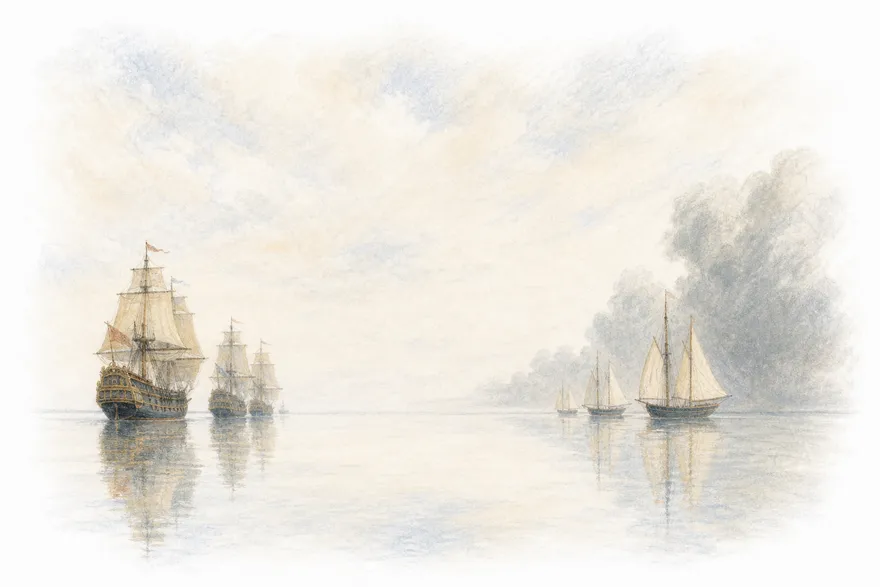
For eighty years a storm stands in the middle of the water. Both shores call it the Dragon’s Breath, and both pray to the dragon whose sleeping breath it is, though the storm has answered no prayer in living memory. It is a standing wall of black weather, taller than any tower raised against it and wider than a season’s sailing. It lets nothing pass. Fishermen dare fifty leagues out, feel the current under their keels begin to pull, and turn for home, and say nothing to their wives. Then the storm tires, as all great things tire, and lies down, and for eleven months the sea is grey glass from one shore to the other. This is the Opening. The fleets of two worlds put out upon the calm and meet in the middle of an ocean that has kept them strangers since their grandfathers were boys. They trade, and stare, and do not fight. They carry pieces of one another home. A man is fortunate to see a single Opening. Few live to see two.
The old law of the sea-peace forbids any man to spill blood on a calm sea, and men keep it first for the plain reason that nobody burns the one market of his lifetime. Under the plain reason lies an older one. The peace was broken once, in an Opening past anyone’s grandmother, a prize taken on the grey glass. Every song on either shore agrees that the men who took it never came home. There the agreement ends. In the east the water opened under them, quiet as a held breath. In the west the fleets of both worlds hanged them from their own yards while the sea lay flat and watched. No admiral since has cared to learn which verse is true, and so the peace keeps itself, the one law in two worlds enforced by a question.
What comes home in the bright months is silver and silk and spice that will be gone from the larders by winter, and a few foreign habits that pass through mouths and markets until the city mistakes them for its own. The ledgers keep all of this, and the songs remember it. A woman wears her grandmother’s western combs to her wedding without once thinking of the sea.
The rest does not look like cargo, and so the rest goes unwritten.
In the hold of some homecoming ship there is always a smaller thing. A handful of pale grain, four Openings gone, that fattened a starving people and bought them forty years of the wars they had been too hungry to fight before. An edge of foreign steel that held where the old iron broke, so that smiths who had kept a secret three generations woke to find it worth nothing and their sons poor. A fever folded into a bale of cloth, that walked ashore on no legs and gave a whole city to the gulls. A trick for reckoning a debt; a page no hand had copied; a way of throwing a pot; a word for a thing that had always gone without one. Small enough, each of them, that a tired clerk waved it through the customs house, finding on it no smell and no blade.
And a world ended. It ended as a tide takes a sandbar, grain by grain, in the dark, while the village sleeps. No one climbs the dune until the morning the old coast is simply gone, and the children stand on the new shore and swear to you it is the only shore there ever was.
This is the eightieth year. Out past the last grey teeth of the storm, the wall is sinking again, and the wide water has begun to lie down to die. The fleets are caulking their hulls and salting their meat and quarreling already over the price of a market that does not yet exist. Men have quarreled like this at the turn of every Opening anyone thought to write down. In the counting-houses, old men are teaching their grandsons the western numbers. In the temples, the priests are rehearsing the blessing of the keels.
But the keepers of the old memory, who count the years and are paid to count them truly, have lately begun to keep two tallies. The tally they show the city reads as it has always read, steady as a tolling bell, eighty and eighty and eighty again. The tally they keep for themselves does not. The years are coming faster. And the sea, which once slept as the dead sleep, has begun to stir, and to turn, and almost to wake, as a vast thing will when it is nearly done with resting.
The fleets do not feel it moving beneath their keels.
They wait for the bell that will tell them the old words still hold. In every harbor of two worlds, the first ropes are being loosened.
Chapter One
First Keel
I.
The Cormorant should not have been at sea.
Every soul aboard her knew it, and most of them blamed Rob Vane, which was fair, because it was true. They were twenty weeks out of the last port on their own side of the world, a sealers’ hole called the Kettles, at the rim of the storm where the charts went white, running east for home with a hold full of trouble, and Rob had driven her into the dying weeks of a storm that had ruled this water since before any man aboard was born, on a wager the whole crew had heard him make and only a fool would have taken: that she could make Dorynthos harbor before the priests rang the year open. The storm was not done with her yet.
The boy Col had the dawn watch at the pump, and he was singing. He was sixteen, the youngest aboard, a harbor boy on his first deep water, and he sang at the pump when he was frightened because his own voice steadied him better than the charm sewn into his cap, which he was ashamed of and kept anyway. The cook had fed him double the whole voyage out, on the grounds that the boy was still growing and the rest of them were past helping, and when the barrels ran short the second helping had gone on coming, quietly, off the cook’s own plate, which the watch knew and let alone. He had signed for an eighth-share. The night before they sailed, Rob had heard him on the quay telling a girl what an eighth-share of a first keel came to, and getting the sum wrong, and making it bigger.
The Dragon’s Breath was dying, and a dying thing is the most dangerous kind. For weeks it had stood like a cathedral roof of black water, walls with no interest in sinking a ship, only in turning her back. Now the walls were coming down. The swells had fallen from mountains to forty feet and then toward thirty, but they ran crossed, two seas out of step, so the hull dropped into holes that had no bottom and clawed up faces that had no top, and everything not lashed twice was already gone.
The sea that took Col came over the port quarter while the ship was still shaking off the one before it. Rob saw it the whole way in. It was green and solid as a toppling wall, and it buried the waist of the ship to a man’s height, and when it had drained off the deck the pump was still turning on its own weight and the boy was gone from it. His lifeline swung empty, parted at the splice he had been taught to make on the voyage’s first morning. For one breath there was a head in the water astern, a dark point on a grey hill, there and then not. Every man on deck looked at it. Then every man on deck looked at Rob.
“Boat!” someone was screaming, halfway to the falls already. “Boat, for the love of...”
“No boat.” The words were out of Rob before he felt himself choose them, in the flat carrying voice he kept for weather, and they were the right words. No boat ever built would live two minutes in a crossed sea, and the men who manned it would follow the boy down. Coming about would lay her beam-on in the troughs and drown the rest of them inside the hour, forty men spent for one already past saving. Every captain on this ocean knew that arithmetic, and the arithmetic was sound, and he would make the same answer again tomorrow. None of it helped. He had smiled at the boy’s wrong sum on the quay, and said nothing, and sailed.
The cook came up the ladder with the boy’s bowl still in his hand, looked at the empty pump, and went below again without a word. Tomas put his palm flat against the knot of red thread he had nailed to the mainmast, where he let no man near it, and held it there a long time, his lips moving. The cook had spat to leeward before every watch of the voyage; the boy had carried his mother’s charm; their observances half contradicted one another and worked just often enough that no sailor alive would put out without his own, and the boy had drowned with his in his cap. Rob let them all be at it. A captain who took a man’s charms took his nerve with them, and nerve was the only cargo left between here and the land.
Holst came aft along the lifeline hand over hand and did not trouble to lower his voice for the helmsman, which was a message in itself.
“That’s the first,” the sailing master said. “Of forty-one. You’ll want to be keeping count.”
“I keep it.”
“Bram said turn back three days ago. I said it twelve days before that, in the roads, with the anchor down and every man of them alive.” Under the streaming hood Holst’s face had gone past anger; anger needs somewhere to go. He had taken the owner’s wage and sailed against his own counsel, and he would work the helm of this wager until it killed him, and he would never once say aloud that the choice had also been his. “Write the boy in your book, captain. First price paid against your week of market.”
“It’s written. Get her head up two points. The sets are coming longer.”
That was true, and Holst heard that it was true, and went, because seamanship was the one tongue the two of them still traded in good coin.
A week of market. That was the whole venture as Holst told it, and Rob stood at the weather rail with the spray going over him and let the words do their work, because a man who has just drowned a boy owes the sum an honest reading. Two winters ago he had worked the Cormorant west along the coast of Alkos, port by port, until the ports gave out and then the coast did. Never once toward the far shore; nothing but a fleet in a declared year lives on the wide Typhon. The trick was smaller and stranger than a crossing. At the world’s ragged end, where the storm stands over the water all year, the dead man’s box had named a factor: a house’s man-on-the-spot, the breed that sits in a far port buying and selling and waiting on a master’s word, sometimes for a lifetime. This one had handed over a cargo ten years in a cellar, asked nothing, and seemed glad to see the back of it. Then Rob had turned her east and run for home with everything riding on the timing: in a few weeks the priests would walk to the end of the Dorynthos breakwater, read the water, and ring the Opening in, and the patient fleets of two worlds would put out for the eleven lawful months. A keel that made harbor ahead of that bell would name the year’s first prices and choose its friends while the great houses were still provisioning. Every master on the coast knew it. What kept them all at anchor was the calendar, which said the sea could not open this year, and the storm, which was supposed to agree with it. Rob had bet the sea against the calendar. That was his whole crime: a few stolen weeks, bought against the chance of drowning, and until this morning the price had been seasickness and short sleep.
The old man lay lashed in his nest of oilcloth and tarred wool by the mainmast, ninety-one years old and dry as a relic, and Rob went and crouched beside him, because there was nowhere on the ship he wanted less to be than alone with himself. Bram could not always say what year it stood, or whose deck he lay on. But he had crossed the Typhon itself, shore to shore and back, a boy of eleven on the last keel home before the storm stood up again, and on his good hours he could still tell a lull from a trap, and that was the only reason a sane captain carried ninety-one years of dead weight onto this water.
“She used to sleep cleaner,” Bram said, without opening his eyes. The rain ran in the seams of his face as though the face had been made for draining it. “Last time the walls dropped, they dropped and stayed down. This one’s twitching.” He turned his cheek against the streaming deck, comfortable as a man in a feather bed, with the worn-smooth calm of the very old. “Like a dog dreaming.”
“And when a dog dreams?”
“You let it lie. You don’t go walking on its back.” His eyes opened, pale, rinsed of their color by eighty years of weather. “I told you that in the roads.”
“You did.”
“And here we are, walking.” He patted the deck twice, fondly, the old hand light as paper. Then he went back to the other thing, as he always did when the water ran high: a small run of words in no tongue Rob knew, in an order that never changed by a hair. A cradle-song, he had said once, the one his own mother sang on her last crossing, long drowned and still on his lips. Rob had stopped hearing it years ago, as a man stops hearing a hull work. Today, with the boy an hour in the water and the sea alive under them, he could not stop.
The cry came up from below at the change of watch, and it was the one a sailor fears worse than any wave. Water in the hold.
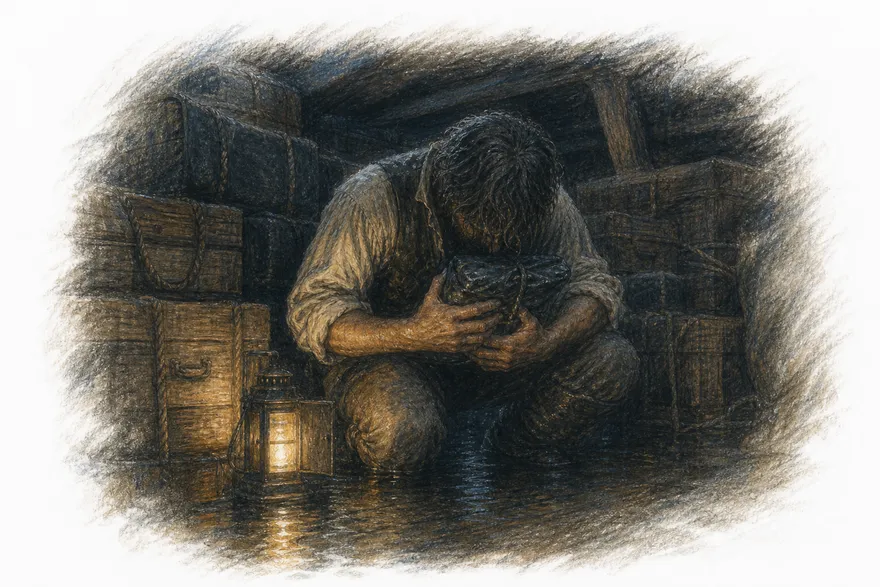
He took the ladder down into the dark and the reek of the bilge. Two men were already on the after pump, and a third crawled the cargo with a shuttered lantern, hunting the spring among the bales, the lantern-light sliding over the honest freight as he went: ironwood, resin, minted silver, ballast in every sense, carried so a customs man would have something to tax and no reason to keep asking. The true venture rode aft on a shelf above the waterline, in an oilcloth packet a man could carry in two hands: a set of small metal letters cast in reverse, and a book no scribe had ever copied, every page stamped out a hundred to the hundred. His father had left him the way to it in a locked box, a drowned man’s scraps: a far-shore seal, a factor’s name, and a warning ten years old about books that make priests poor.
The water was gaining on the pump, and it was climbing toward the shelf. A barrel worked loose somewhere forward and came down the tilting hold at him end over end, and he watched it the whole way and stepped off its line at the last foot, and it stove itself to splinters against the mast-step where he had been standing. The men on the pump shouted at him to get above, that this was their work, and they were right. A captain’s place with water in the hold was on deck with his ship; he had known that since before his voice broke. He went aft along the flooded walkway instead, and took the packet down off the shelf, and held it against his chest with both arms while the ship tried twice to throw him off his feet, and carried it up the ladder ahead of the men, ahead of the pumps, ahead of the ship. Somewhere off behind his own eyes a colder man stood and watched him do it, and understood at last what he was.
He could read perhaps two words in five of the book, and he had read enough. The Calm came and went on a count any patient man could keep for himself, it said, and no blessing sung over a departing keel had ever moved it by an hour. It was a small book, and it could pull down towers.
That was the reason a clever man gave for carrying it, and it was even true. It only wasn’t why he had sailed.
He had been born four minutes before Edmund. Four minutes, and he had spent forty years learning exactly what they bought. Edmund had been handed the rest of it, the straight nose, the easy symmetry, the good Vane face that made men on a guild bench trust him before he spoke. The sea had paid Rob in different coin: a nose broken twice, skin cured to tack-leather, hands gone to rope and salt, a body that read ten years older than his brother’s and had earned every one of them honestly. Women liked him for a night; it was Edmund they married. Isobel had married Edmund. Rob had stood in her father’s hall in a borrowed coat and wished them joy, and meant nearly all of it, and gone down to the harbor that same night to look at a ship he could not yet afford. Eleven days later he was over the horizon. The truth the dying storm had finally shaken loose of him was small and shameful and his own. He had not sailed off the edge of the charts to grow rich. He had done it to come home too large to set down again.
It was a contemptible reason to drown a boy of sixteen, and he had drowned one with it this morning, and the venture was not over.
The storm took five more days to die, and it died as the old man had said it would, twitching. The crossed seas untangled themselves a little more each watch, the walls coming down into long grey ridges that ran under the ship instead of at her, and twice in those days the sky opened on a sun nobody trusted, and twice closed again. The seam they had patched with a spare topsail held to a weep the pumps could live with, watch and watch about, and the men worked them in a silence that had not been aboard before. No one sang at the pump now. The watches changed around the boy’s absence as men step around an open hatch, and the cook fed the morning watch and fed no one double.
They were eating green rope by then. The last sound barrels had gone weeks back, and what remained was the kind of stores a crew chews rather than swallows, and two of the hands had gums gone soft and dark with it. The cook called the mess the alderman’s dinner, the same joke every day for half a year, and it had outlived the storm and even the boy, because at sea a bad joke keeps where a good one spoils. Hunger on a ship is a weather: it slows the work and shortens the tempers and lengthens the days, and the days were long already. Rob stood his own tricks at the pump, which a captain need not do, and knew to the man which of the crew thought better of him for it and which thought worse. He slept the dead hours in the lee of the helm and snored, hugely, as he had snored across half the world; the port watch held you could box the compass by it, and Rob, who had never once heard himself, maintained it was the hull working.
On the third evening he sat by Bram through the dog watch and counted leagues in his head, a habit he had been told his whole life was a vice: so many run, so many left to run, the wager closing its books. Somewhere east, under this same dying sky, the priests would be out on their breakwater, watching the water and not yet saying what they saw. Every day the storm spent dying was a day off the head start he had bought with a boy. He was aware that he had begun to think of it that way, as spending, and he let himself be disgusted by it, and kept the count anyway.
The cry came down from the rigging at the turn of the afternoon watch on the fifth day, and it was the other cry, the one that empties a man of everything he had been carrying. The lookout was jabbing both arms at the bow.
For a moment there was only cloud. Then the rain thinned, and beneath the dark bank of the storm lay a darker line that did not move. Land. On the line, small against the grey, catching the one pale break of light in all that ruined sky, stood thirteen towers. The castles of Dorynthos: one for the Duke, one for the army, three for the navy, three for the university, and five for the guilds, squat and old and richer than any crown.
“First keel,” Holst said at his shoulder, and for the first time in twenty weeks the grievance had gone out of his voice, because the words left no room for it. A first keel mattered for her news before her hold: proof, visible from the walls, that the sea had gone passable while the calendar still swore it was shut, and news like that named the price of everything before there was a market to argue back. Every man on deck stood looking at the towers, and every man on deck was rich, and they had all stopped believing in it months ago, and there it stood.
Then the sea ahead of them began to rise.
It rose past thirty feet and kept rising, hauling itself up one last time out of the whole dying width of the storm, a wall taller than anything the Breath had thrown in weeks, leaning over the little ship as if to see what had been worth waking for.
“Up the face!” Holst was already spinning the wheel. “Take her up! Take her UP!”
The ironwood bow came round to the wall of water, slow, slow, and the Cormorant, forty souls and a stamped book in her belly, put her shoulder into the sea and began against all sense to climb.
II.
In the city that wall of water was climbing toward, behind the thirteen towers the lookout had sighted, his brother’s wife sat with a dead man’s letter and could not make it lie quiet.
Isobel Vane still heard the name as borrowed. Two winters of marriage had not worn it in. She worked by the north light of the Letterers’ castle, in the long cold room where the League of the merchant cities kept the things that had to outlive the people who made them, and her breath stood in the air in front of the page.
The letter had come to her sideways, as all the hard work came to her. A fellow of the house had carried it to her table without quite meeting her eye, said the hand had defeated the upstairs room, and gone away again to wait for her reading, which would be entered in the ledger over his name. That was the arrangement. No one had ever proposed it aloud, and everyone kept it. She was tall in a room where she was always seated, and striking in a guild that preferred not to look at her, and the Master’s own daughter in a house that would die before it gave a woman a chair. So she had learned to do her real thinking where no one watched it happen, in plain Letterers’ grey, over pages other people would be praised for.
This page was why rooms like hers existed. Isobel read the old dead Mysoan better than anyone alive, a useless gift in the shut years and worth more than ships in the one year the sea opened, and this was that year. The letter came from the kontor, the League’s trading-house on the Mysoan shore, half warehouse and half embassy, the walled yard where eastern merchants lived under their own law in a foreign port, kept alive across the closed decades by factors who sailed over young, married local, and died foreign. It had come on no ship; nothing came on ships in the closed years. It had come the slow way, passed hand to hand around the long northern ice, the better part of ten years in the carrying, and the man who wrote it had been dust before it cleared the halfway portage. To read it was to hear a voice from the bottom of a well.
She translated like a woman crossing rotten stairs, a word at a time, testing her weight.
…and so the Question that troubled them when last the sea was open troubles them still, but louder, on account of the stamped books, which multiply faster than the temples can burn them. They no longer ask whether the Calm is a mercy. They ask whether it is only a tide, with a cause a man might measure, and needing no priest to beg it. I do not know how it ends here. You will know, on your side, long before I do. Look to your own temples, when the books come over.
Isobel set down her pen and sat still while the cold worked through her sleeves. She understood exactly what these few stale lines were worth, and who would pay for them, and who would kill for them. A warning ten years old was still ten years of warning, to whoever held it first.
She had been raised to fear pages like this one. Her father had drilled the catalogue of the Openings into her before she could write, prayer by prayer: the pale grain, the red fever, the foreign steel, every harmless-looking thing the sea had carried across and the world each one had quietly ended. The Vane house itself stood in that catalogue, brought down the year before the twins were born by a western fashion in contracts that no one inside it understood until the warehouses stood in another man’s name. She had grown up four streets from both brothers, and chosen between them for reasons she had told her father were rational, and two winters on she was no longer sure which of them she had been punishing.
There was one more item in the catalogue, a small one, that she had never said aloud because she could not make it mean anything. The Openings did not keep their time. Eighty years, the priests said, fixed as the bell. But the old dates in the Letterers’ own rolls did not quite hold the figure. Eighty-three, the once. Then eighty-one. And now this one arriving a year and more early, in the wrong beast’s year by every count the rolls kept, on a storm that twitched in its sleep instead of lying down. A handful of years stolen back across three centuries, and the theft quickening. Rounding, her father had called it, old men counting badly in the dark, and she had let it lie, because she was a Letterer’s daughter and knew that a pattern with no mechanism is only a shape you are frightened of.
The under-master’s clerk came down the room at dusk with the docket-book, collecting the day. The letter would be entered, summarized, and carried up; the masters would read her summary over their wine, under the fellow’s name, and decide what the League should know and when. The clerk stood at her shoulder, blowing on his fingers, while she wrote out the docket in her fair round hand: private letter, kontor of Mysos, family and trade matters, prices of wool and alum, the writer’s health failing. All of it true. All of it on the page. She left the Question lying where it lay, in a tongue no one upstairs would sit with long enough to break, and her pen did not so much as slow.
When the clerk had gone she did the other thing, the one she had been deciding all afternoon without admitting the decision was made. She took a half-sheet of waste vellum, wrote out the Question paragraph whole, the Mysoan above and her own tongue below, folded it twice, and slid it into her sleeve against her wrist, where she would feel it for the rest of the evening like a splinter. The League owned the letter. No one owned the meaning. Her father had a word for people who thought that way, and the word was heretic, and he used it lovingly, and he was right.
Because there was a keel on the water. If the harbor talk of the last three days was true, somewhere out in the dying storm a single reckless venture was beating in ahead of the bell, weeks ahead of a world that still sat at anchor waiting for leave to sail, and there was only one man mad enough to be standing on it, and the books this dead factor feared would be in its hold. She had signed none of its papers. She had been waiting for it, she understood now, for two winters, dreading it and hoping for it in the same breath and unable to tell the two apart, and the letter against her wrist had just told her what it would carry.
She did not hear Edmund come in. She never did. He moved through the world without disturbing it, which she had once mistaken, all the way through, for peace.
III.
Edmund Vane came home from the Diet with the look of a man carrying water in his cupped hands.
He set his gloves down before he spoke. He always did that first, squaring them edge to edge on the table by the door, and Isobel had learned to read the day’s weather from the gloves long before he opened his mouth: gently for a day won, precisely for a day lost. Tonight he set them down precisely. Then he moved the left one a quarter-inch, as if it had disappointed him.
“They’ll vote the monopoly,” he said. “The Coin guild, and three others, and the priests behind them. One license for the whole Opening, under the Duke’s seal, and whoever holds it names the price on every hull that moves.” He sat down heavily by the fire, still in his gown, which was unlike him; the fur at the collar was dark where the harbor fog had been at it. He looked tired in the particular way of a careful man who has spent a whole day being right in a room full of people who profit from his being wrong. “The draft went round the benches today. Anyone who put out on his own coin, betting on open trade and a first keel: finished. As it’s written, his cargo is contraband the moment it touches the stones.”
“The moment it touches the stones,” Isobel said. “Not the moment the bell rings.”
“As it’s written. The clause reaches back to the first day of the thaw.” He held his hands to the fire. “The committee sits within the week, and I mean to gut that line on the floor of it. Seizure to run from the Declaration and no earlier. Landed cargo ransomed at value instead of taken. Days of grace for any keel already at sea before the seal.” He said it evenly, in his bench voice. “I’ll have the small houses with me, and perhaps two of the navy castles. I counted the room today, and the votes against are bought already. It is the best clause I will ever get a hearing for, and I do not expect to get it.”
He said all of it as news of the world. He did not say his brother’s name. The not-saying filled the room like smoke.
Edmund kept a private ledger, and it had not balanced in two winters, and he no longer opened it even to himself. He had won. That was the unbearable part. The seat, bought with ten years of patience. The name, half scrubbed clean of its old ruin. The woman, asleep an arm’s length from him every night of the world. Even the face, the good Vane face that had fallen to the careful brother instead of the bold one and that opened doors all on its own, so that he could never afterward be certain a single door had opened for anything he had done. He could not name one thing he held that he had taken from Rob in fair contest. He had only ever picked up what Rob set down. A man can love his brother with the whole heart he shows the world and still, down in the silt beneath the love where he does not go with a lamp, need him gone.
And now the Diet had laid a knife on the table and called it law.
Because he knew what was out on the water. The whole harbor knew by now: an independent keel, ironwood-built, sighted twice in the dying storm, standing in for the harbor while every lawful hull on the coast still swung at anchor waiting on the bell, and there was one venture reckless enough to be that keel and one man fool enough to be standing on it. And Edmund had seen today, reading the draft at his own bench, with the clean horror of a man who is good at sums, the whole shape of the thing he would never have to do. If the charter passed as written, whenever it passed, land the keel early or late, the law would do quietly what he would never let his own hands do. It would seize the cargo and break the venture and put Rob Vane back out to sea a beggar, too poor to stay and too proud to be kept. And Edmund would fight the clause. He would fight it honestly, on the record, before witnesses, and he already knew, having counted the room, that he would lose, and a man who has fought and lost has done what a man can do. He could feel that thought arranging itself in him already, smooth as a clerk laying out papers for a signature, and he hated it, and he did not send it away.
“It’s Rob’s keel,” Isobel said. It was not a question.
So she had heard. Of course she had heard. He looked at her face for what he was afraid to find in it, and could not be sure he had not found it: attention. Worse than love, attention, and harder to forgive. It was the stillness she fell into over a difficult page, the whole mind arriving at the table at once, and she had turned it on him.
“We don’t know it’s his,” Edmund said.
“We do.”
“We know it’s ironwood, and early, and mad. Half a coast could fit it.”
“Edmund.” She turned the dead man’s letter face-down on the table, gently, as if covering a sleeper. “When the charter comes to the floor. Which way does your guild bind you?”
He could lie to the Diet; lying to the Diet was half the work of sitting in it. He could lie to the priests with a clear heart, since everyone lied to the priests. He found, as he found every time, that he could not lie to her, and it felt like a weakness, and he hated it uselessly, as he hated the clerkly thought.
“It binds me to the monopoly,” he said. “When it comes to the floor, I’ll vote the gate.”
“And your brother?”
“I’ll fight for the clause that would spare him.” The fire ate a knot in the wood and spat. “There are men on my bench who would tell you that’s one fight more than I owe him.”
“That isn’t what I asked.”
“No.” He looked at his hands. “Ask it, then.”
“If it comes to an hour when you could be quick for him, or slow,” she said, “which will you be?”
He thought of the committee room waiting for him at the week’s end, and the votes he had already counted, and of how restful it was going to be, underneath the honest anger, to lose.
“I don’t know,” he said.
It was the truest thing he had said all day, and he watched her hear it.
Below the castle and beyond the walls, the great bronze bell of the Temple of the Calm began to ring the hour, the slow note that had counted the city through every dynasty and every sacking, the note that within the month would ring in an Opening and make the whole world lawful. And somewhere out past the harbor mouth, past the last grey teeth of the storm, a hull of ironwood was climbing the back of the final wave with forty souls aboard and a stamped book in her belly that called the bell a liar.
Edmund Vane sat watching the fire with his wife’s eyes on him, weighing his brother’s life against his own thin peace on a scale he had spent two winters pretending he did not own.
He did not yet know which way it would fall.
In men like him, it is the not-knowing that does the harm.
Chapter Two
The Undeclared Sea
I.
The Cormorant came into Dorynthos a week before the world was allowed to.
She had lived through the last wall of the dying storm, though Rob could not afterward have told anyone how. He remembered the bow going up the black face of it past all sense, and Holst’s voice gone to a thread, and old Bram lashed to the mainmast still muttering his cradle-song into the spray, as though the water were a child he could quiet. Then the wall had passed under them instead of over, and after it came the long grey nothing of a beaten sea, and then the land.
A hundred and forty-three days, the western breakwater to this one. They had sailed with full casks and a fat ship, and they came in gaunt, the last barrels gone to a green rope you chewed before it would go down, two of the deckhands with their gums turned soft and black. One man the water had taken, and taken whole, owing them no hammock and no stone at the feet: Col, the boy, five days short of sighting the land he had signed on to see. Rob had read the words over the ship’s empty wake himself, because there is no priest within a thousand leagues of the Typhon and never has been. His eighth-share sat in the venture’s book with a line drawn under it. That was what being first had cost before the city even knew they existed.
Now the oars came in, and the Cormorant slid through a harbor that did not yet know what to do with her.
By rights the sea was still closed. The Dragon-priests had not yet walked to the end of the breakwater in their sea-green, read the water, and declared the year open, and until they did there was no Opening and no market, only a city holding its breath at the edge of its oldest habit. The good berths stood roped off for great houses that had not arrived. The customs men were not at their desks, because there was officially nothing in the world to clerk. For a few days the busiest harbor alive belonged to whoever was reckless enough to be standing in it, and Rob Vane stood in it, with a thing in an oilcloth packet worth a fortune for exactly as long as it stayed legal to own.
He had beaten the bell by a week, perhaps less. The moment the priests declared, the moment the charter the whole quarter was whispering about came down out of the Diet, the font stopped being cargo and became contraband, and the man holding it stopped being a merchant and became a heretic. A week to turn it into money, or favor, or a foothold in some house too big to search. Today, if he could manage today.
They brought her against a slick of empty stone below the Temple’s own quarter, nothing better being open to them. Tomas went over the side first, touched the red thread at his collar and then the wet stone, his small private business at every landfall. The cook spat to leeward and would not look across the basin at the plague quay, with its white posts and tarred rope and the little stone house where the Temple’s health-men would sleep once the year was declared. No lamp burned there yet. Officially there was no west for anyone to have come from. The dockmen kept their distance all the same, and made the sign against fever with the hands they thought he could not see. Their grandmothers had taught them what an Opening could carry.
Bram watched from his nest of tarred wool at the rail as Rob swung the packet up onto his own shoulder, and something cleared in the old man’s face, some current of an older day running through it.
“You went, then,” Bram said. “I told you the once-in-a-life wasn’t worth the water, and you went west anyway.” He said it fondly, scolding a man he was glad to see. “And here you are home with your little box, and you’ll tell them all it was for the money.”
“It’s Rob, Bram.” He said it gently. He had said it many times. “My father’s ten years drowned.”
“Is he,” Bram said, agreeable, his gaze already sliding back to the water. “Is he. Well.” And then, as Rob put his leg over the rail: “Mind the box, boy. It came dearer than you’ll ever let on.” And he went back to the cradle-song, the small run of words that never changed by a hair.
Rob stood on the stones with the weight on his shoulder and felt the old grief turn over once and settle. His father had gone down with the rest of what the family had been, ten years past, and Bram confused the living and the dead now, confused noon with forty years gone. It meant nothing. He shifted the packet higher and climbed.
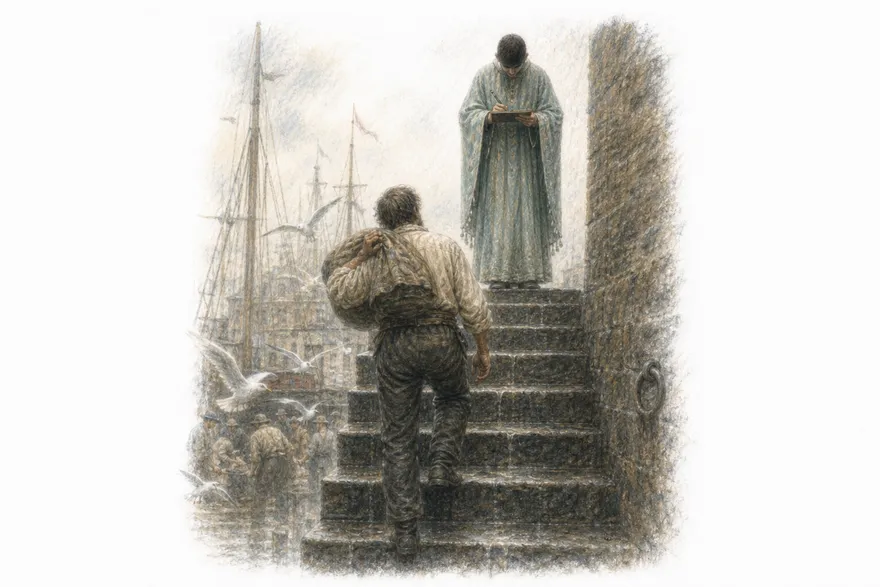
He was three steps up the water-stairs when the priest came down them.
A Calm-priest, alone but for a Temple clerk at his back, in the sea-grey-green that read across a crowd like a flag, the hem of his robe weighted with small beads of lead so that the silk hung as still as standing water while he walked. He was younger than Rob, smooth-shaven, with the unhurried look of a man whose institution had outlived eleven dynasties, and he stopped where the stair was narrowest, so that passing him would have been its own small declaration.
“Captain,” the priest said, pleasantly. “You’re early.”
“The sea was kind.”
“The sea is closed.” Still pleasant. The clerk behind him had produced, without being asked, a little tablet of wax. “There has been no reading and no Declaration. Whatever you crossed, captain, it was not the lawful sea, which makes you an interesting question, of a kind I am told the Diet is presently drafting an answer to.” His eyes went along the rail of the ship behind Rob, man by man, counting gums and ribs the way a buyer counts faults in a horse. “Sickness aboard?”
“Scurvy, outbound. None now.”
“Dead?”
“One. The sea took him.”
“His name will be wanted, for the prayers.” The priest’s gaze came back and settled, with the weightless ease of a fly landing, on the oilcloth packet. “And that?”
“Ship’s papers,” Rob said. “And my father’s letters. He’s ten years dead. I carried them out, and I’m carrying them home.”
The clerk’s stylus moved. The priest looked at him a moment longer, the harbor wind doing nothing at all to the weighted hem.
“Vane,” he said, tasting it. “The ironwood Vanes, that were. Well.” He stepped aside at last, arranging the silk with one finger. “The water will be read within days, captain, not weeks. When the bell rings, everything in this harbor becomes lawful or becomes evidence. Be found clean.”
He went on down the stairs toward the ship, not hurrying, trailing his clerk, and Rob made himself climb up into the city at a pace that said nothing at all, with the most dangerous thing he had ever owned riding on his shoulder and his name sitting in wet wax in a stranger’s hand.
At the first fish-stall above the water-stairs a woman saw the tar on his sleeves, the salt-white in his beard, the closed harbor behind him, and pulled her child in by the collar and shut the plank over her fish with a clap. The next stall did the same. By the third he had stopped looking. Fear ran up the hill ahead of him, faster than any bell.
II.
The man he wanted was a factor named Voss, who kept no sign over his door because everyone in Dorynthos who needed him already knew where it was.
Voss bought and placed things that were difficult to buy or place. In the lean years Rob had used him to turn a disputed wreck off the eastern shoals into clean coin, and Voss had been fair, which was the most a man could ask of anyone in that trade. He kept his counting-room three flights up, warmed by a sea-coal fire, one wall hung with a faded chart of a coast that had changed owners twice since the cloth was woven, and he sat in a dark gown trimmed in marten, dressed a long way better than his plain street door let on, and he did not get up.
“First keel,” he said. “The whole quarter is saying it and not one man in ten believes it, and here you are, dripping on my floor to settle the wager. Sit. You’ve come to make me rich or to get me hanged, and I’d like to know which before my clerk pours the wine.” He took in the tarred wool, the salt-burnt ruin of Rob’s face, and under the amusement something quicker had already begun to move.
The clerk poured, and set down with the wine a dish of barley bread and oil, factor’s courtesy. Rob managed four mannerly bites and then stopped pretending, a hundred and forty-three days of green rope arriving at the table all at once, and Voss watched him mop the dish clean without a word and had the clerk bring another.
Rob had a gaunt ship to refit, a crew four months unpaid, and backers in two cities who would want the venture turned to money before the law arrived to give it another name. He sat, set the packet on the table, and folded the oilcloth back from the metal.
Voss looked at the small grey letters a long while without touching them. He was not a man who needed telling what a thing was, and Rob watched the wanting and the fear arrive in him together and begin to fight.
“A whole fount,” he said at last, mostly to the metal. “Cut and cast, and not a hand on this coast that could make its like. The Temple bought the casting trade out of the world after the last press war, shop by shop, and what it could not buy it buried, and the stamp has kept the grave weeded for eighty years. Block-cutters we have. Licensed presses we have, a reader standing at every one, every sheet stamped or burned. What you have put on my table is the missing trade entire, in a box one man can carry: the means to print anything, for anyone, with no seal on it and no reader at your shoulder, faster than a hundred copyists and cheaper than one. There is no price for such a thing, captain. There are only buyers.”
“You know what the priests do when they find this,” he went on. “And the charter coming will make the owning of it a hanging matter, not a fining one. So hear the part you climbed three flights not to hear. There is no quiet way to sell you this. The only purses in this city that could pay what it is worth, and actually use it, belong to the great houses, and a house does not buy a secret. It buys the secret and the man who carried it in. The hour I place this, somebody powerful knows your name and knows exactly what you ran ahead of the gate.”
He set the type down as carefully as he had chosen the words. “So don’t place it. Sink it off the breakwater tonight and sleep easy. Or put your ship back out and lie up in some cold cove until the fleet comes and the bell rings and the price is only a price. Be anywhere in the world but in this city, holding the one thing the new law is being written to hang.”
Stairs taken two at a time made a particular sound in that quiet house, and they made it now. The clerk came up, bent to his master’s ear, and Voss listened with his eyes on the type, and his face rearranged itself by a single degree.
“The priests went out along the breakwater at first light,” he said. “All of them, the readers in front. They’ve begun on the water.” He folded his hands. “An hour ago you had a week, captain. Now I’d call it three days, and I find the arithmetic has changed for both of us. What I said stands, and it stands taller. Sink it, or sail. Every hour that sits in my room it grows more valuable and more likely to hang us both, and those two lines cross very soon.”
It was good counsel, and the second time it was better. Rob heard it as plainly as he had heard Bram tell him to come about, three days into the dying storm. He thought of the boy he had not been able to bury, and the forty ashore who wanted paying, and the long grey creep-home life of being poor and careful and overlooked, the exact man he had crossed the world not to become. The room was warm and the chair was dry, and he had been in neither for half a year, and somewhere under his breastbone the last wave was still rising.
“You’re right,” he said. “Place it.”
Voss’s eyes went to the stamped pages still under the metal. “The book with it. A house will pay double for the pair.”
“No.” He could read perhaps two words in five of it, the Mysoan drifted half a tongue out from under him, and a man did not sell what he could not price. There was one reader in Dorynthos who could take the book whole, from the first line to the last, and the thought of carrying it to her had its own kind of weather in it. He drew the oilcloth back over the book.
“Then less,” Voss said, without heat. A thing sold in halves never fetched a whole price.
They settled it inside the hour the news had left them, over a jug of thin Dorynth wine. There was no coin to be had so early, nothing being yet legal to trade, so Voss paid the only way the season allowed: paper. A standing credit in the Gate House of the Coin guild, entered in Rob’s own name, in a ledger that would outlast the bell and the year and every man now living. It was less than the font was worth and more than a careful man would have taken, and Rob signed under it with the room’s good pen, R. Vane, in the strong schoolless hand his mother had paid a clerk to beat into him. He had gone to the end of the world for a trinket and walked out with a place, his name set into a great house’s book in the very same stroke.
At the door Voss told him again, almost gently, to spend it slowly and to be elsewhere when the bell rang. Rob took it for a factor’s manners. Going down the three flights he kept his mind on the refit, which worked for exactly as long as there were stairs.
III.
By the time he reached the water the wondering had caught him up, and it had teeth.
The Coin guild. Of course it had been the Coin guild. They were the spine of the charter, the house pushing hardest for the single gate, and Voss was the sort who knew a month early which way the powerful would jump and made certain he had something in hand to sell them when they landed. The font sat now in the strong-room of the one faction whose law would, inside the week, make the holding of it a death. That would trouble them not at all. Laws of that kind are written with a door in them, and the men who write them keep the key. And under the font, on a numbered page, in his own wet ink, stood the name of the man who had carried it through the gate before there was a gate. They would never even have to hunt him. He had signed himself in at the door.
He did not let himself think about who else kept a seat on that bench. There was a bench, and there were men on it, and one of the men had his face. He thought about the tide instead.
The crew wanted paying. Holst had them mustered on the quay in the last light, gaunt and salt-burned, shifting on their feet with the strangeness of stone under them, and Rob went down the line putting Gate House drafts into hands that had earned coin. He knew what every man in the line meant to do with his share, having heard it all watch by watch for half a year, and he paid the wish out with the wages: Brey’s tavern with a roof on it at last, Tomas’s mother’s leaking one, the cook’s sworn intention to die somewhere that did not move, and the carpenter’s, sworn nightly the whole way home, which was to sit once, like a lord, on a privy that did not pitch, with a door on it and no sea in his lap. The line laughed more than paper deserved.
“Paper,” Holst said, last in the line, not yet taking his.
“Paper today. Coin when the bell rings and the season opens. Or the Gate House discounts it at the door tonight, for any man who’d rather drink it.”
Holst turned the draft over and studied the seal pressed into the corner, the little gate and balance of the Coin guild, for longer than there were words on the paper. “We crossed the world’s end ahead of every law there is,” he said, “and you’ve paid us out of the house that’s writing the next one.” He folded it once and put it away inside his oilskin. “It spends, I suppose.”
“The boy’s share,” Rob said, when the line was done. “I’ll carry it to his mother myself.”
“No,” Holst said. “You won’t.” He took Col’s draft off the top of the stack, neat as lifting a card. “She’ll have it from a man who argued against the sailing. It will spend better.”
He went off up the quay with the boy’s wages in his oilskin, and Rob stood and let him go, because it was just, and because nothing he could say would have made it less so.
Then he walked back along the water to find Bram, with the book under his arm and the evening coming down, because Bram was the one man left in Dorynthos who had known his father, and he wanted, for no reason he could have defended with money, to ask him what the west had been, and what his father had been in it, back when the family had a fleet instead of a story. But Bram was asleep in his nest of tarred wool, dreaming back down the long water, and the cradle-song was still moving on his lips, every word in its place, with the perfect fidelity his waking mind had lost. Rob stood over him a while in the dusk and did not wake him.
Past them both, the harbor had begun, here and there, to light its first lamps. Tomorrow he would see the ship into the yard and find a clean coat and begin being the man who had done the thing no one believed could be done. The bell would ring within days, and the world would arrive, all the patient fleets of it, and find him already standing on the stones with a great house’s paper in his pocket. He had wanted to come home too large to set down again. He had managed it in an afternoon. It had cost a boy and a name in a ledger, and he ran the sum once, came up short, and decided the light was too poor for counting.
And somewhere up in the high castles, in a warm room above the Gate House’s evening lamps, a man Rob Vane would never meet dipped a pen, read a new line in a ledger, and began to consider what it was worth, and to whom.
Chapter Three
The Master’s Daughter
I.
The hand had been dead two hundred years, and Isobel Vane could hear its owner clearing his throat.
It was a deed in old chancery Mysoan, dated in the second year of the bone otter, the ink gone to rust, the letters crushed together by a clerk who had been paid by the page and not the hour. Three Letterers with thirty years and a fellowship apiece between them had marked it illegible and set it aside. Isobel had it open under the north light within the hour. Reading a hand like this was mostly listening: a tired man at the end of a long day, dropping the tails off his letters because his wrist ached, telling you in the slope of every word exactly where he had stopped caring. By the second cold hour she had the whole of it, a wharf and two storehouses and the right to a freshwater spring, sold for a sum that would not now buy the spring.
She wrote out the fair copy in her own even hand and carried it to the under-master. He thanked her kindly and entered it in the ledger under the name of his son.
She said nothing, because she had learned what being right out loud cost in a room of men who outranked her by everything except ability. She allowed herself one thing. In the colophon, where the fair copy named the hand that had made it, she had written the son’s name in the crooked old spelling his family had paid a herald to abolish, as she had on every copy for three years. No one had ever noticed, which was the point, and also the joke. She went back to the long table that was hers only because it sat under the draft from the north window and no one else would take the cold. She cracked her knuckles, one hand and then the other, a stevedore’s habit her mother had spent twenty years failing to whip out of her, and let the old anger settle into the thing it always became in her, which was work.
The cold room of the Letterers ran the length of the castle’s seaward wall, and it held the one kind of wealth in Dorynthos that could not be eaten or spent or lost in a sacking: its memory. A life was not long enough to see two Openings. Between one and the next the great names changed and the coastlines silted and the old contracts went strange, so that without someone to keep the thread an heir could not read what his own grandfather had signed. The Letterers kept the thread. The room smelled of vellum and of the clove-oil they worked into the bindings against worm, and in the cold months your breath stood in the air in front of the page.
By every count in the room, this should not have been the year. The Opening belonged to the golden dragon, as it had for as long as the Round had been kept, and the golden dragon stood a year and more off; this was the bone gull’s year, a year for mending nets and burying quietly. Yet the storm was dying out of season, and the harbor talked of nothing else, and the priests, who alone might say what year it was, had gone very carefully silent. Isobel had been raised to the dragon’s year the way other children are bound to a trade, and here it came, early, wearing the wrong beast, and she was spending it copying a dead man’s wharf for a living man’s son. Her father’s project, the long reconstruction, the recovery of the first words from the wreck the centuries had made of them, had been the whole weather of her childhood. It was now eleven years stalled. You cannot rebuild a tongue from half of itself, and the other half had lain on the far side of a shut sea since before she was born. The Opening was the door. It was the only door that would open in her lifetime, and she was on the wrong side of it in a grey dress, with no chair of her own.
The bread-boy carried the harbor talk up with the noon loaves, because he was twelve and could not keep a marvel behind his teeth. A keel had come in ahead of the storm, he said, weeks before the priests would allow it, the first keel, and it had carried a book. A book no hand had copied: a book that was a hundred books, every letter the twin of the last, stamped out of metal in the living Mysoan of the far shore.
Isobel set down her pen so that it made no sound at all.
Not ten days past, a dead man’s letter had crossed her table, ten years on the road around the ice, and told her to look to her own temples when the books came over. She had docketed the warning as trade matters and copied the dangerous paragraph into her sleeve and thought the next decade would make it good. The decade had taken a week.
And a book in modern Mysoan. The far branch of the tongue, current and breathing, a long way downstream of every dead word she owned. The one thing her father’s whole life had been waiting for, in her city, tonight, in the hands of a sailor who could not read a line of it.
She found her father in the map room, and for once she did not soften it. The western book was in the harbor, she told him. He knew what it was worth to the project, better than any man alive and second only to her. Let him go to the guild and the Duke tonight and claim it for the Letterers, and put it on her table, where it belonged.
Her father had been Master of the Letterers for thirty years, and the city had long ago worn his name, Ambrose, down to the office. He had built her himself, hour by hour at the cold table, into the instrument his life’s work needed, and he was proud of her with a pride that had never once included a plan to set her free. He heard her out as he heard novices construe, nodding in the right places, filing the errors for later. Then he laid his old hand over the back of hers and told her to be patient. The book was heresy off a heretic press. The Temple would want it burned and the charter-men would want it leashed, and a wise guild let the powerful wear themselves out on a thing before reaching for it. “Wait,” he said. “Your year is long.”
He was probably right. He usually was. But being right about the long game was a luxury of people whose year was not running out, and hers was. Eleven months, and a week of it already spent.
She thought of her husband, who sat on the very bench drafting the law that would make the book a hanging matter, and who would tell her, gently and correctly, to keep clear of it and of the man who had carried it in. Then she took down her plainest cloak, the grey one that let her cross the city as nobody, and went out into the falling dark, down toward the water, to find Rob Vane herself.
II.
The harbor at night was a different city.
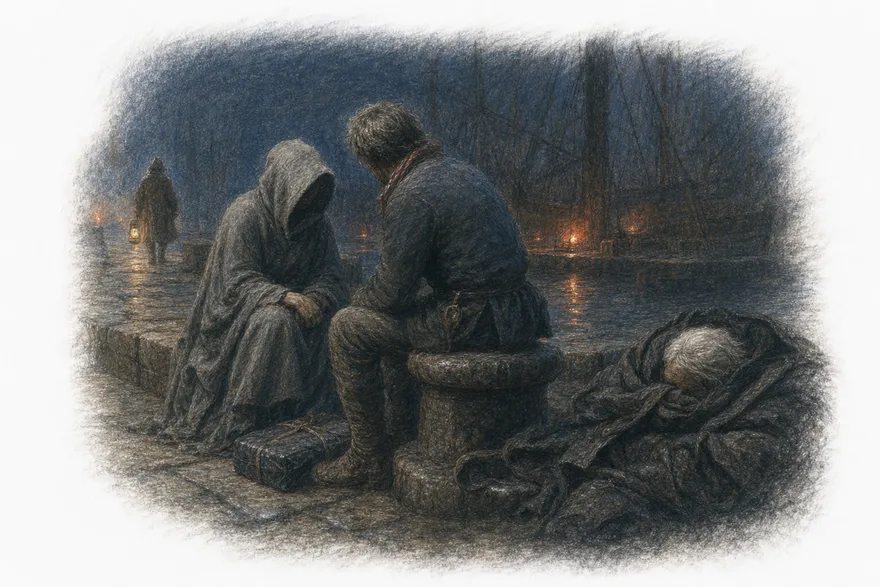
The great houses had put out their lamps, and the only light was the low red of the watch-fires and the lantern far out on the breakwater, where within the week the priests would stand and declare the year. She found him where the fish-market gave onto the bare dark stone, sitting on a bollard with his back to Dorynthos and his face to the black water, an oilcloth bundle at his feet and an old man asleep in tarred wool beside him.
Four months of sea had pared him down to rope and salt and the old twice-broken nose. He was forty and looked older, and her heart did the thing it had been doing since she was nineteen, which was to clench once, hard, and then pretend it had not.
He knew her step before he turned. Neither of them remarked on it.
“They let the Master’s daughter out after dark,” he said.
“They don’t.” She sat down on the cold stone beside him as though she had every right to, which she did not, and they both knew it.
They had grown up four streets apart, the merchants’ children and the Letterers’ children all one small guarded class. She had known both brothers before she had the word for the choice she would one day have to make between them. She had chosen the careful one. She had told her father it was the rational choice, the roof over the fire, and she had been believed, because she was good at being believed. Rob had said nothing then, and he said nothing now, and the nothing was the loudest thing on the quay.
“You kept a book off that keel,” she said. “You sold the metal and you kept the pages, because you couldn’t read enough of them to know what you had, and you would not be cheated on a thing you couldn’t price.”
He looked at her then, full on. “Voss said there was one reader in the city who could take it whole.”
“He was right.”
“He usually is. It’s how he stays poor.” He nudged the oilcloth with his boot. “It will hang the man who owns it, the morning the bell rings. Your husband’s friends saw to that. So what does the Letterers’ table pay, for a thing it hangs a man to hold?”
“Nothing,” Isobel said. “You won’t sell it. You had Voss under your fist for a week and sold him everything off that keel but this. Then you carried it the length of the harbor and sat down on the open quay, where the first person who came down the hill would find you. A man minded to sell doesn’t sit with his back to the buyers.” She laid her hand flat on the oilcloth. “Name a price if it comforts you.”
“I forgot what it was like,” he said, “being read.”
“I know. It’s death to hold, it touches Edmund, it touches me. I’ve weighed all of it.” She let that sit. “And I want you to put it in the only hands it was ever any use to. It crossed the world to be read, and I am the reading of it. Everything else that happens to it is waste.” She heard her own voice go flat and certain, the way it only did about the work, and did not care that he heard it too.
He was quiet a while, the water working at the stones below them. Then he lifted the oilcloth bundle, held it a moment in both hands as he had held it coming off the ship, and laid it across her knees. It was heavier than a book had any right to be.
Down the quay a lantern came swinging out of the fish-market, the watch on its slow round, a tuneless whistle under it. Neither of them moved. The light came up the stones and passed over a man and a woman sitting close above a parcel of oilcloth, found nothing in them worth a second swing, and went on toward the breakwater. Rob waited until it was small.
“I thought of bringing it to you,” he said, low, almost a confession. “The whole way up the harbor I told myself it was because you could read it. That was true. It was not the half of why.”
She stood with the book against her chest before either of them could make the moment into more than it would survive being. “Don’t be in the city when the bell rings, Rob,” she said, which was the only kindness she had to give him, and was the same one a factor had given him that afternoon. Then she went back up into the dark with the most dangerous book in the world held against her like a child, and the watch-light still swinging small and yellow at the far end of the stones.
III.
She did not take it to the house she kept with Edmund.
She took it back to the cold room, where the north light was long gone and the candles made small gold rooms of their own in the dark, and she opened it alone, her breath standing in the air and the smell of worm and clove all around her.
She read the argument first, because she could not help it. It was patient, and it was deadly. It left the Calm exactly where it had always stood, and took out from under it only the priest. The sea came and went on a count a man could keep for himself, the book said, and no blessing ever sung over a departing keel had moved it by a single hour. So the tenth the Dragon-priests took for declaring the year was a toll on the sunrise. The dead factor had written that the far shore no longer asked whether the Calm was a mercy. Here was what they asked instead, set in metal, multiplied past burning.
That alone would have been enough to burn for. It was the fourth leaf that stopped her breath, where the book set down the old blessing itself in order to mock it, the calm-prayer the priests sang over the keels, printed in the living Mysoan so the reader could see how empty a thing it was.
Isobel knew that prayer. She knew it in her own dead Alkan, a whole sea away from the form on the page, and she had spent eleven years with the two halves of it too far apart to bridge. Here they lay on a single leaf, the western form under her finger and the eastern in her memory, one prayer grown apart in two mouths across the centuries. At its center sat the word the whole blessing hung on, the word that asked the water to be still, and the two languages disagreed about it like two honest witnesses, each one certain, each one wrong. The west had worn the middle of the word down to one short vowel. Her Alkan had split it in two and put a hitch between. She set the forms side by side in the candlelight and did what she did with ruined hands: asked what original would explain both mistakes at once. And the older word, the parent both had fallen from, rose up between its daughters and into her like cold water going down the throat. It stood apart from both of them, a long weight in its middle that neither tongue had kept, a sound she could hear in the mind’s ear and could not write, because no alphabet on either shore had a letter for it anymore. She set it down in a mark of her own invention. For the first time in her life she was holding both ends of a broken thing, and she could see exactly where it had snapped.
She should have written it out and gone home. She sat instead with the word in her mouth like a held coin and thought the thought all the way through, which was that no living person could say this by accident. The priests would sing the blessing’s granddaughter over a hundred keels in the spring, and half a world away the west mumbled its own worn daughter over fishing boats, and the sea did as it pleased and always had, because close was another word altogether, a cousin where only the son would do. The form on her slate had been extinct longer than the castle under her had stood. There was exactly one mouth in the world it could come out of tonight.
Because she was who she was and had waited her whole life to be it, she said it aloud, softly, and got it wrong. Her own Alkan reached up out of her childhood and split the middle of the word along the old familiar seam, and what stood in the air was almost the word, a cousin of it, and the candle-flame leaned slowly away from her as if a door had opened somewhere, though every door was shut. She sat very still until the flame righted itself. Then she corrected herself as she would have corrected a pupil, without mercy and without haste: lengthened the middle, set the lost weight down where her own mark said it lived, and spoke the word that no alphabet could write.
The candle-flame in front of her stopped moving. It had not guttered, and nothing had breathed on it. It stood straight and still as a flame in a painting. At the same moment every small sound of the old castle, the settling timber, the wind worrying the shutter, the sea below, went out of the room together, so that for the length of one held breath there was nothing in the world but the word she had spoken and the stillness it had made. Then the flame leaned and burned again, and the wind came back, and the sea, and Isobel found she had risen from the bench and stepped back from the page without having decided to.
A draft, she told herself. And then, because she was honest by trade: two drafts, a minute apart, with opposite manners. A lull in the wind off the water. She was a translator and not a credulous girl, and the dead did not sit up because you read their letters. But her hands were not steady, and under the fear, treacherous and enormous, sat the purest joy she had felt in eleven years, because whatever had moved in the room, the word had been right. She had rebuilt a true thing out of its broken halves and the world had answered her, and there was no living soul she could ever tell. Her father would call it heresy and her husband would call it ruin, and both of them would be correct, and neither would understand that it changed nothing, because she already knew she was going to do it again.
She wrapped the book back in its oilcloth and hid it under the loose flag beneath her own cold seat, the worst chair in the room, where no one who credited her with anything would ever think to look.
There was a toll that first night, so small it never reached any list she kept. Putting out the candles, she went looking for the homely word for the little brass cap on its stick, her first tongue’s own word, worn smooth by thirty years of bedtimes, and it was not there. Gone, clean, like a coin through a known hole in a pocket. It would come back to her at her own gate an hour later, ordinary as ever and a little cold; for now she put the lapse down to the hour, which is where everyone puts the first one.
Then she sat in the dark with her hands in her lap until they went still, the only person in the world who knew that the priests had been telling a kind of truth all along, and that it was far worse than the lie.
Interlude
The Homecoming Chest
The oldest woman on the lane was named for a city that had changed its name twice since she last saw it.
She had come over at the last Opening, a girl of nine on her father’s contract, and she had not gone back. The fleet that should have carried her home sailed three days before her father could close his accounts. Then the storm stood up again, and that was that. She married here, buried a husband here, raised children who spoke the harbor tongue in the street and her tongue only at her own table. Now she was the last on the lane who remembered the far shore with her own eyes, and the sea beyond the breakwater had begun, at last, to lie down.
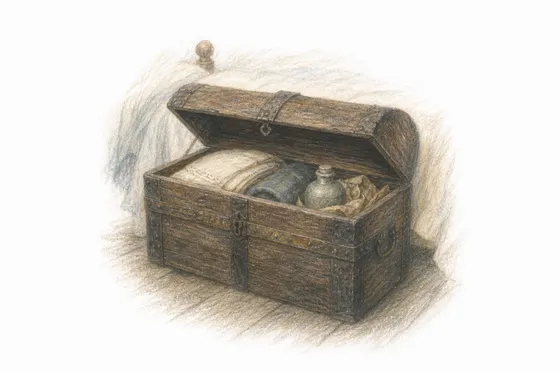
At the foot of her bed stood the chest.
It had been packed for the voyage home, and the voyage had never come. Linen folded for a girl of nine, a good wool cloak gone hard at the folds, her father’s seal, a stoppered jar of the grey salt they cured fish with at home and nowhere else, all of it laid in oilcloth against the damp and never once lifted out. Her daughter had repacked it twice as the moth found it. Her granddaughter thought of it mostly as the thing that would have to be carried down three flights when the old woman died, and was ashamed of the thought, and had it anyway.
The granddaughter was called Mara, and she was Faring on both sides and had never been anywhere. The children at the cistern called her wrack, the weed the tide leaves on the stones, and she had learned young to hit the ones who said it to her face. At home her grandmother used the other word, the one the old people kept for themselves: the Faring, the still-going, as though being aground here were only a pause in a crossing that would of course resume.
“They’ll open the year within the month,” Mara said, because the whole harbor was saying it. “We could put you on the first decent keel. You could see it.”
Her grandmother looked at the ceiling and said a soft word Mara did not know, one of the old ones, and then said in the harbor tongue that there was nothing to see. The city she remembered was gone. The lane she was born on had passed through three owners and a fire before she ever left it. The people who would have known her face were bones now. Sailing home only carried you to a strange shore that happened to use your grandmother’s word for the bread.
She still sang, some nights, the songs her own mother had sung her on the crossing, in the cadence of a place that no longer shaped its words that way. A man from the Letterers’ castle had come once with a slate and a stick of chalk and paid her good silver to sing them slowly while he wrote, and had gone away looking as though he had found coin inside a wall. She never understood what he wanted with them. They were only the songs you sang to a child on the water, so the water would let the child sleep.
She died three weeks later, two days after the priests walked the breakwater and declared the year open. They laid her with her face to the west, the way the Faring lay their dead, turned toward the shore she had spent a whole life not reaching.
Mara did not open the chest. She carried it down the three flights, as she had always known she would, and set it by the door, packed and ready, in case.
Chapter Four
The Coin Bench
I.
The widow Sell had dressed her three sons for a hanging, and it was only a hearing.
They sat in a row at the back of the wool-hall where the League’s merchant-law sat in session, scrubbed and stiff in their temple clothes, and their mother stood in front of the weigh-beam with her hands folded so that nobody would see what trade had done to them. Madder, to the wrist. Twenty years of red dye in the creases of her knuckles, and a wool factor named Harst at the front table explaining, with great patience and a lawyer at each elbow, why those hands should now work for him.
Edmund Vane had taken her case for nothing, which his clerk found unaccountable and his guild would have found worse. He could not have explained it to either of them in a way that did them credit. The truth was that he had read the called surety twice the evening it crossed his desk, and the arithmetic of it had offended him: a bond written in a dead year against a dye-house worth forty pounds, called in the one season the house would shortly be worth two hundred. Harst was a competent grab, nothing more. Every man in the city with money loose was buying capacity before the bell, vats and lofts and rope-walks, anything that would still be standing when the year turned everything to gold. The law was about to make a great many men rich, and it had occurred to Harst that it could be persuaded to do it a few weeks early, at a widow’s expense.
It had occurred to Edmund that it could not, and finding the reason why had been the purest two hours of his month.
“The bond is plain,” Harst’s lawyer was saying. “Payable at the Opening of the sea, or in the tenth year of the bond, whichever falls first. The tenth year is two years off. And the sea, your honors will have noticed, is opening.” A small laugh for that, around the hall. The storm had been dying for a week. There was not a soul on the coast who did not know what was coming; the harbor pilots had tripled their fees and grain was selling on rumor, forward, twice.
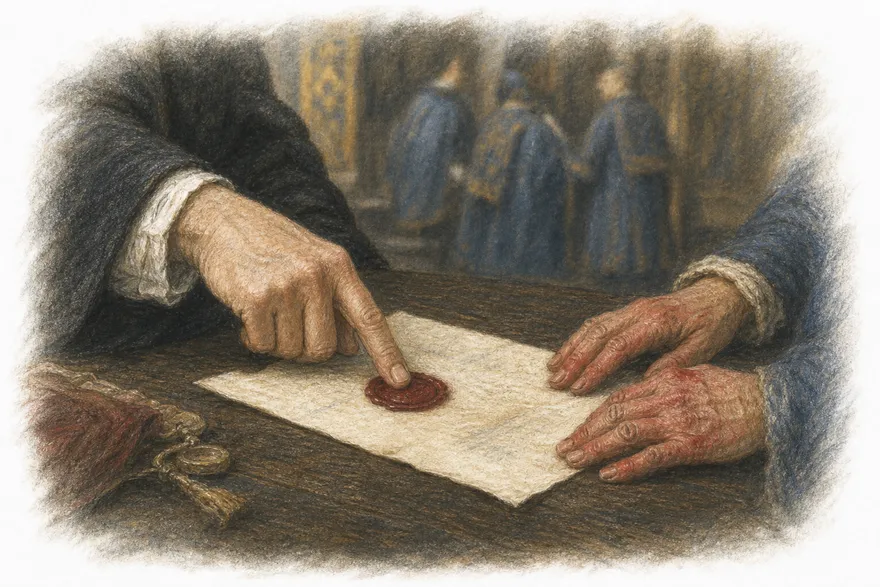
Edmund rose, and laid the bond on the table, and put one finger on the seal.
“The sea,” he said, “is weather. The Opening is law. They are relatives, and they are not twins, and this hall of all halls should know the difference.” He did not look at the bench when their quills came up; he had them already, and looking would have spent it. “The Opening of the sea is a thing that exists when the Temple declares the year, and at no other hour. That is not piety, masters. It is the only ground this court has ever stood on. Every bond in this city that says at the Opening means at the bell, or no bond in this city means anything at all.” He turned the seal toward Harst, gently, like a man returning a borrowed knife. “Master Harst has sold the year before the bell. The law does not deal in weather. It deals in wax.”
The presiding master looked at the bond for a long moment, mostly, Edmund judged, for dignity, and ruled the call premature: void until Declaration, with costs to Harst. The wool factor took it well, which confirmed Edmund’s reading of him; a grab, declined, and he would go and grab elsewhere before sundown and think no more of it. The widow Sell did not take it well. She cried, briefly and furiously, with her back to her sons so they would not see, and then tried to pay him from a purse that had perhaps a pound in it.
“The hall paid me,” he said, which was untrue. “It’s a fee case.”
She looked at him the level way that women who run yards look at men who run words, sorting what was kind in it from what was convenient. “They say it on the bench side of the hall,” she said finally, “that you’re the kind one.” And she gathered her boys and her bond and went back down the hill to her vats, leaving Edmund Vane, syndic of the Coin, in possession of a sentence he would carry around all day like a coin he kept checking for.
The kind one. He had won, and won fairly, by being better at the law of the thing than two lawyers and a grab, and what the city would remember was that it had been kind. Nothing he held had ever felt won. The seat had come when old Merrick died childless; the name he had rebuilt had been his father’s; even his marriage, he knew in the silt under everything, had been a settling and he the thing settled for. But this morning’s two hours had been his, start to finish, fair, and no one would ever count it, and he was ashamed how long the taste of it lasted.
In the corridor afterward, under the wool-hall’s painted beam where some guild ancestor had had the thirteen castles of the coast picked out in gilt, Lord Harne of the uplands fell into step beside him. Fur at his collar in the wrong season, rents in grain on land that had not changed value in eighty years, and the particular hunger of a man whose blood outranked everyone in the building and whose purse outranked no one.
“A clean piece of work in there, Vane.” Harne walked a few steps. “Tell me a thing, since you know this hall. When a house falls, its land comes here, to the registry. If a Temple house should ever fall. An abbey, say.” He said it idly, the idlest sentence Edmund had heard in a year. “Where would a man register title?”
“Nowhere, my lord. Abbey land cannot fall. It is held in the Calm’s own hand, in perpetuity.”
“In perpetuity,” Harne agreed pleasantly, and went away down the corridor like a man who had been told a price rather than a law.
Edmund stood a moment under the gilded castles and then put the exchange where he put everything that had no present use, and went to the afternoon’s real business, which was the charter.
II.
On the way to the Coin guild he stopped at the chestnut woman’s brazier at the foot of the wool-hall steps, as he did every sitting day, and ate them walking, out of the paper, too hot, scalding his fingers and his tongue. It was the one purchase of his life that had never gone into any book.
The committee met in the Coin guild’s long room, under the bad portraits, and you could read the whole coast in the seating before a word was said. The Calvers men sat together by the door in their navy broadcloth, arithmetical and bored: Calvers had two royal castles to victual and three years of arrears owed it from the Crown’s yards, and it would vote for any paper whose seal paid its docks, and everyone knew it, including the Calvers men, who had stopped pretending otherwise a session ago. Ostrane’s three sat in the middle of the room with their hats on their knees, fingering the brims, devout at home and mercantile at sea and embarrassed in both directions, waiting, as Ostrane always waited, to find out what it would be frightened of this week. The middle of the Diet followed Ostrane the way water follows a tilt. And at the end of the table stood Vael’s bench, empty, polished, eloquent. Vael had sent its answer by sending nothing.
The Duke’s man came first, a smooth gentleman in plum velvet who used the word harmony four times and the word tenth once, the once being the matter: his Grace would consent to charter a single gate for the dragon-year trade, the license to be auctioned at his Grace’s pleasure, a tenth of the gate to the ducal purse. The room had expected a twentieth. The room adjusted. Land cannot buy an Opening, Edmund thought, watching the plum velvet bow itself out, and so the land has decided to tax the door instead, and there was nothing in the thought he could use, so he filed it.
The Temple’s price came second, and it came in person.
The provost was a dry, narrow man of sixty in the sea-green of the Calm clergy, and where the hem of any dock priest swung and snapped as he walked, the provost’s hung dead still, weighted through with lead beads, so that he moved down the long room like something that did not displace air. He set one page on the table. He had a voice you leaned in for, which Edmund understood at once to be a tool, and the page said, beneath the seals and the courtesies: no license but to a man in good standing of the Temple, his standing proven at the rite of his keel, year upon year.
The committee bent over it. Most of them read the politics, which were plain enough: a single gate is a single altar, and the Temple would bless the monopoly because the monopoly could be made to kneel. Edmund read the working end. Good standing, proven at the rite, year upon year, meant a priest’s discretion renewed annually over every license in the gate, which meant the clause was a leash before it was a wall. It barred the quarter’s brokers outright; that was the visible edge, and the Calvers men were already nodding at it, a tidy bone for the devout. The quieter edge was that good standing had no floor and no ceiling. It would bar whomever the Temple, in any given year, found it useful to have barred. He began, professionally, in the margin of his mind, the list of houses that died of this clause as written: the two Sereth shipping families first, then the small independent houses too poor to keep a chaplain sweet, then any keel whose papers had ever been irregular, any keel that had, say, run ahead of a bell.
He stopped the list there, by hand.
The elder Calvers man said the quiet part comfortably, to the bench at large, by way of approving the page: the gate should be kept by the old keels, the houses of the founding blood, men whose grandfathers had built the breakwater; the quarter’s brokers could keep to their own gate, behind their own little door, and handle what they were fitted for, which was one another’s paper. There was laughter of the seconding kind. Edmund neither joined it nor declined it. He turned the page he was holding at the natural place, neither sooner nor later, and the minute-book, which recorded amendments to the schedule of fees, recorded nothing, because nothing, at law, had been said.
The clerk’s circular had come around the benches an hour before, between the Duke’s tenth and the Temple’s page, and the room had enjoyed it, because a committee room enjoys nothing better than someone else’s catastrophe: a keel in early, in ahead of the storm, if the harbor talk could be believed, its cargo already gone quietly to the trades, the Gate House holding paper on the wages. Laughter down the table. Some gull has sold the year before the bell, said the younger Calvers man, pleased with himself, and Edmund had felt the morning’s own sentence come back to him wearing different clothes, and had written, in his small exact hand, in the true margin of the actual draft: forfeiture, runs from Declaration or from landing? and had not answered it, and had turned the page.
He did not ask the name of the keel. No one told him the name of the keel. He was careful, the whole of that long afternoon, in a hall where he knew every man and every man owed him conversation, to be nowhere the name might be said. A thing you are not told is a thing you do not know. At law.
The caucus afterward was brief, because the line was already written. The Coin guild would back the charter, with amendments as to the schedule of the gate’s fees; its bench would vote as one. Edmund stood and proposed his amendments anyway, because some part of him had decided to be able to say, later, that he had: seizure to run from the Declaration and no earlier, landed cargo ransomed at value, sixty days’ grace for any keel at sea before the seal, to land and declare and come into the law before the law came for it. He made it well. He made it, he knew, better than it deserved, the dead grace clause of the winter session cut down and re-stitched to fit the new paper, and the caucus heard him out with the respect owed a colleague’s funeral and voted it down eleven to three. Nothing personal was in it. The gate paid better narrow. That was the whole of the argument against, and no one even troubled to say it aloud.
He had promised Isobel the committee floor. He had delivered the caucus: a shut door, his own bench, no minute-book to remember the count. The floor would have gone no differently, he told himself, and it was true, and he was the one man in the hall best equipped to know that true was not the point.
Then the subscription book came down the table, the guild’s line fair-copied at the head of the page, and the syndics signed in order of seniority, and when it reached him Edmund Vane signed with a steady hand, and noted that it was steady, as one notes a stranger’s manners.
The provost was at his shoulder as the room emptied. He had a gift, Edmund would learn, for being at shoulders.
“Syndic Vane.” The dead-still hem, the dry voice you leaned toward. “The grace clause. The winter session, and again, I am told, this afternoon.” A pause that was not a hesitation. “A well-argued loss. The Temple keeps minutes.”
“It lost,” Edmund said.
“Losses tell us more about a man than his wins,” said the provost. “A win can be bought.” He inclined his head the precise degree the chamber owed a syndic, and was gone down the room without seeming to spend any motion on it, and Edmund stood with what the man had given him, which was the only sentence anyone had ever said aloud to the exact wound, said as a compliment, by the author of the clause he had just signed his name beneath.
He went home in the blue dark with the day stacked in him like unposted entries, and could not have said, if his own clerk had asked it, which column the day belonged in.
III.
Isobel was home before him, which was usual, and had eaten, which was usual, and sat across the supper table while he ate, with her glass of thin wine, which was their treaty and as close to ease as the house came. He ate too fast and a little too much, as he always did on a losing day. The house ran as her mind ran, exact and quiet: the linen pressed to edges, the one lamp trimmed so it did not smoke, the accounts in her hand to the halfpenny in a book he never had to ask for. People called it a cold house. It had never once been a disorderly one, and Edmund, who had grown up in the wreck of a falling name, valued that above warmth and had married accordingly, and told himself so on the regular occasions when the telling was needed.
She asked about the committee. He gave her the shape of it: the tenth, the Temple’s page, the line subscribed. He did not mention the grace clause; he had buried that column already.
“And it runs from the bell,” she said. “The whole of it. Nothing reaches back?” She was turning her glass by the stem, watching the lamp through it. “If a cargo came in before the Declaration, say. Would the law reach back for it?”
“That’s being argued,” he said, and heard, a half-second too late, the shape of his own margin in her mouth.
She nodded as though the answer were of no consequence and asked whether the Calvers men had worn their blue. That was the table’s one standing joke, two winters old now, from a session the whole Calvers bench had come to new-cut from the same bolt, like the crew of something, and he gave it what it was owed: they had, and the youngest had a new coat besides, in a blue so loud the harbor could signal by it. Isobel laughed, short and low, before she could decide to, and the table went on into smaller things. But Edmund sat a moment inside a small surprised warmth, because in two winters she had asked him perhaps four questions about the bench, and now two inside ten days, each with the working end out. She had asked as she asked about a gloss: precisely, because she wanted the answer. He decided, turning his cup, that something in the marriage was thickening at last, as ice thickens, quietly, from beneath, and the figure pleased him and he did not examine it.
After, in the small room he kept for papers, he opened the lower drawer of the desk with the key he carried on his watch-chain. The drawer held what it always held. A flat deal box with his mother’s rings. The deed to the house. And at the bottom, where it had lain for twenty years, a thin canvas ledger with two boys’ writing on its face, VANE BROS., COASTWISE, his own hand at fifteen ruled and exact, and above it his brother’s at sixteen, gone up the cover like gulls blown across a page. Two summers of a borrowed boat, cabbages and roof-slate and one cask of brandy they had never accounted to anyone, the profit split to the halfpenny and entered fair. He knew the final figure. He had not opened the ledger since the year the house fell, and he did not open it now.
He laid the day’s caucus paper in the drawer on top of it, the guild’s line with his name subscribed, and turned the key, and the lock made the sound of a thing done properly.
Somewhere below the hill, past the watch-fires, a man whose name he had been careful all day not to be told was selling a year the bell had not rung. The bell would ring within the week. The law would run from the bell, or it would reach back; that was being argued, and he was one of the men who would argue it.
He put the key back on the chain, and went up to his wife.
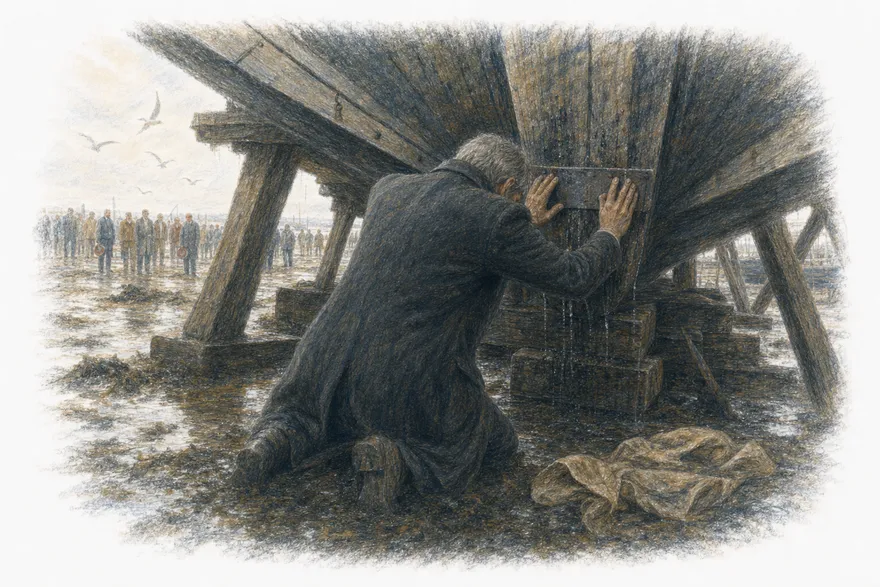
Chapter Five
The Keel-Rite
I.
The Temple kept a fixed price for proving that a man believed in God, and Cassian Marl had paid it every spring for twenty years.
The whole schedule hung on the door of the rite-house at the harbor stairs, vellum gone amber under a century of varnish: so much for the ringing of a keel under forty tons, so much over, so much for a house’s first proving, so much to have a reader’s attendance entered under seal. The prices were quoted in temple-marks, a coin no mint had struck in two hundred years, so that paying them required a changer, and the Temple kept a changer in the porch at a rate the Temple set, and none of this was written anywhere, and it had outlived four dukes.
Marl paid at the porch, took his chit, and went down the stairs into the smell of low water.
The rite ran with the tide. Once a year, on the last good ebb before the Declaration was looked for, the sea pulled back and showed the city the bottoms of its ships, and the priests went out along the hards where the hulls sat propped in their cradles, and one house at a time, oldest first, a master climbed down into the weed and the dripping dark under his own keel and proved his standing. The proving was simple. You laid the house-iron flat to the keel where the great timber ran up into the stem, and you said the rite-verse, eleven words in the sacred tongue, and if you said them truly the iron rang.
It should not have worked once. A span of old steel laid against wet wood by a cold hand, and at the last word it sounded, every year, a clean bronze note that had no business coming out of either the steel or the morning, a note that carried over the mud and the weed and the resting hulls like the Temple’s own bell made small. A hundred and some houses would ring before the tide turned. The whole city came down to hear it, bareheaded, the harbor quarter in its red felt caps with the caps in their hands, and the gulls went up off the mud at each note and settled and went up again, and nobody alive had ever thought to find any of it strange. It was the rite. It rang because it had always rung, as bread rose and babies came. The one wonder of the morning, by common agreement, was the price on the door.
Marl stood in the queue at the stair-head with his iron wrapped in oiled linen under his arm, and watched the Temple bar two houses in front of the entire city, with nothing in its hands but a list.
It was done very quietly. There was a table at the head of the stairs, and a clerk at the table with the roll of standings, and beside the clerk a reader in sea-green whose hem hung dead still in the morning wind, lead beads sewn through the silk so that nothing on him moved but his feet. Marl knew him by the hem before he knew him by the face: the same reader who walked the water-stairs with a wax tablet, the one the harbor had learned this spring to go quiet around. When old Natan vel-Aram came to the table, iron under his arm, the clerk found his name on the roll and did not look up.
“Standing under review,” the clerk said. “The house will not prove this year.”
“Review,” Natan said. He was past seventy, and he had rung that keel himself for forty springs. “Review of what? Name the matter and I will answer it.”
“The review names its own season,” the reader said, pitched just under the wind, so that the whole stair-head had to go still to hear him, and went still. “It is not a finding, master. Nothing has been found.” And that was all. No charge, no gate slammed, no soldiers, only a name unfound on a roll, and a house of four keels and sixty men was out of the year through which all years are fed. The vel-Tessa brothers got the same sentence in the same flat courtesy two places later, and took it worse, the younger one saying loudly that his grandfather had hauled stone for the breakwater the readers walked on, which was true, and helped nothing, because there was no one to argue with. The crowd on the stair-head was very attentive and very silent, men absorbing the news that this could be done, to anyone, at no cost, by a list.
Natan vel-Aram carried his iron back up through that silence with his face perfectly composed, holding the wrapped bundle the way a man holds a grandchild asleep, and Marl, waiting his turn in the queue, did not catch his eye, and the not-catching was a transaction both of them had done before and would do again, and it cost what it always cost.
Then it was his own name, found on the roll without trouble, and the stairs, and the weed-smell and the dark under the Obedient’s keel.
She was a sixty-ton coaster, the one keel the Marl house held outright, and she had come with the name already on her. He had kept it because it cost nothing and reassured everyone. He kept her, if he was honest in the place where he priced things, for exactly one morning a year: this one, so that once a year, in public, at the rate posted on the door, Cassian Marl could prove he believed.
He laid the iron to the keel. The wood wept cold on his wrist. Above him on the hard, faces; at the stair, the hem that did not move. He had drilled the verse the winter he decided to become Cassian Marl, drilled it as a study, the vowel-quantities of a dead liturgical tongue reconstructed from three sources a broker of letters could lay hands on and a priest could not, because priests learn their grace at nine from other priests and never once think about where the length of a vowel lives. It was the best philology of his life and no one would ever know of it. Eleven words. He gave the third its full weight, which the dock-priests clipped. He let the seventh fall where the old meter wanted it, off the beat the processional had taught the city. He said the eleventh word into the wood.
The iron rang.
It rang clean and bronze and unreasonably loud, the full note, the one the city was standing bareheaded for, and it hung in the dark under the hull a half-breath after the iron had left the wood.
Iron does not do that. Sound does not do that. He stood with the note dying around him and the hair on both arms standing up inside his sleeves, and hated it, the hair, the standing, all of it, the body’s stupid insistence on awe in a place where he knew to the syllable what had been done and how. Breath and quantity and a dead language’s table manners. A trick, performed correctly. That the trick rang was the Temple’s embarrassment, since it meant their grace answered to any throat that took the trouble. That it had hung too long was the morning’s damp, or the cradle’s timbers, or nothing.
He came up the stairs with the iron under his arm, and the reader at the table was looking at him: a stylus paused over wax for the length of one held breath, the exact length, it occurred to him later, that the note had hung. Then the entry was made, standing proven, the note fair, and the lead-weighted hem turned away down the table, and Cassian Marl walked up into the city through the crowd’s bared heads with his hands, he observed from a small distance, shaking.
They shook every spring. He had twenty years of calling it fear, and one morning a year when the name would not quite stretch over it.
II.
By noon the clause was trading on the exchange floor like a price sheet, which in every sense that mattered it was.
Copies of a committee draft had no business being out of the wool-hall, and were out anyway, at a half-mark a copy and falling, and Marl read it standing at his desk while the floor below him priced it in real time: standing proven at the rite of his keel, year upon year, the words running under the seals like a quiet tide under a pier. The men on the floor read it as politics and adjusted their books. Marl did what he did with any paper that frightened him. He priced it to the end.
The clause as written killed the vel-Aram keels first, and the vel-Tessas’, which it had in fact already done this morning, before its own ink was law; that was worth knowing in itself, that the law was now trailing the practice, paper sent to tidy up after an appetite. After the Sereth houses went the small independents too poor to keep a chaplain sweet. Then every master whose papers had ever once been irregular. Then any keel that had sailed ahead of any bell. He ran the list all the way out, because finishing lists was the discipline of his trade and the ruin of his sleep, and at the end of it, one stylus-pause away, the last entry wore his own coat.
The floor had been pricing the early keel for a week, too. A man had come in ahead of the bell with, the floor said variously, a printing engine, a plague, a Mysoan bride, and the finger-bones of a western saint, and paper had risen on every version of the story, which told you what the floor actually believed. Marl had brokered nothing for the man and meant to keep it that way as long as his curiosity allowed, which he estimated at a fortnight.
Natan vel-Aram came to his rooms at the second hour after noon.
He came as a stranger comes, hat in hand, shown up by the clerk, and the performance began at the threshold and did not stop: Master Marl, they say you place what others cannot. They said this man had held a canopy-pole steady for four hours at a wedding twenty years ago, too, but only in a quarter the clerk had never entered, in a tongue the clerk would not have recognized through the wall. Marl seated him, and they did the whole liturgy of strangers, the weather, the tide, the season’s freights, two men who had buried each other’s dead.
The matter was simple and the matter was a wreck. A house under review could not clear cargo in the Opening year. Vel-Aram held contracted space in three bottoms and a warehouse of goods bought against the bell, all of it now unsailable under his own name, all of it wanting a buyer this week, and every factor on the floor knew his season was a forced sale the moment the clerk had failed to look up. They would skin him politely by Friday.
“I’ll take the season entire,” Marl said. “Space, stock, and the warehouse lease, at the book values as of the last quarter-day.”
The clerk’s pen stopped. Last quarter-day was before the review, before the tightening, before the forced sale that every man on the floor could smell. It was over the market, and not slightly over, and a broker who paid over the market was either a fool or settling a debt nobody could see, and Cassian Marl was famously not a fool.
The old man looked at him a long moment, with the level patience of seventy years that have held worse mornings than this one. “That is a generous figure, Master Marl.”
“It’s an early one. The market will come up after the bell and I will be holding your season when it does.” Which was true, and was also a coat thrown over the figure, and both of them knew it, and the clerk did not.
At the door, settled, signed, the old man turned with his hat in his hand. He said the city’s farewell, plainly, for the clerk’s ledger and the room’s walls. And then, quietly, in the threshold, in the other tongue, the old words a guest’s host says over a guest leaving, eight syllables Marl had last heard at a graveside, laid down gently and on purpose, like an iron against a keel, to hear what would ring.
“Good day to you, master,” said Cassian Marl.
He stood at the window a while after, watching the old man go up the street, very straight, very slow, among the porters and the sedans. The clerk came in with the signed papers and the look of a man who means to spend his evening retelling the day.
“You paid over the market,” the clerk said.
“The market will come up.”
The clerk gathered the signatures. “Still,” he said, comfortable, a man among his own, “that sort lands soft, master. It goes under the floor with them, cousin to cousin, over the sea; you could starve one a year and he’d come up fat.” He said it as he would have said the glass was falling, a thing everyone knew, requiring no malice and holding it all, and he said it upward, to please. Marl agreed at the cheapest rate available, a sound, half a syllable, the change a man gives when he has finished buying. He kept a purse of such sounds. It never emptied, and it had never once filled. The clerk went down happy, having spent a great day with a great man and been agreed with.
When the boy had gone he sat down and wrote, in the smallest of his working hands, three short notes to three men who did not know one another, concerning a cellar near the print-quarter that wanted lamp-oil, lead, and rent paid quietly for a year. He did not sign them. He folded them into his coat, against his chest, where they sat through the afternoon’s remaining business with the weight of a third address.
III.
He went home by the long way, as always, three streets where nobody followed, a tailor’s passage, the quarter gate with its old insulting little door within the door, and somewhere between the gate and his own threshold, at no point he could ever have marked on a map, Cassian Marl went out like a lamp carried into daylight and it was Esher who knocked, two and one, on a door in the lane of the rope-walks, and was let in.
The house smelled of bread and wet wool. The tide stood at its fortnight slack, and the quarter kept still-water: the sea’s own rest, fallen wherever the moon let it fall, wandering through the Temple’s tidy week on no bell’s leave. Mirel had the still-water cloth on the table, the old one, her grandmother’s, the red thread at its border worn pink at the fold-lines, and the sight of it did to him what it did every time, which after twenty years he had stopped reporting to himself. Her hands were red to the wrist from the wash, and the saffron cord was on her hem where the law put it and where, law or no law, she would have kept it, and she looked at his face for one practiced second and read the whole day off it.
“They barred Natan,” she said. It was the quarter; she’d had it by noon, hours before the exchange.
“They barred Natan. The vel-Tessas too.” He sat. The chair knew him. In this room, things were permitted to. “I bought his season this afternoon. Over the market, at the old book.”
He had expected, he realized, to be praised for it, which should have warned him. Mirel set down the bread and looked at him with the look that had been winning their arguments since before either of them had grey hair.
“Over the market, from Cassian Marl’s hand,” she said. “So now Natan vel-Aram, who held your canopy, goes home owing his deliverance to a stranger’s pity, and can’t even curse properly about it at his own table, because the stranger paid too well to curse.” She sat across from him. “You bought his dignity cheap, husband. He’d have kept more of it if Marl had haggled him bloody like anyone else.”
He opened his mouth to argue the figure, and closed it, because the figure was not the argument and she had already won the one they were actually having. That was the marriage. He brokered all day and lost here nightly, and had crossed a city for twenty years to go on losing.
The lane kept its proof of him on that head, told at every wedding since his own: the young broker who had courted her by appraising her mother’s betrothal carpet, unasked, at three times what her mother had paid for it, with the weaver still alive two doors down to swear to the figure. Twenty years of being right on the floor had never won the carpet back. Mirel brought it out whenever his exactness grew tall, and he had learned to laugh first.
“They came to the stairs this morning to hear you,” she said, relenting exactly as far as suited her, which was her form of mercy. “Bena’s grandsons. Half the lane, in their caps. They wanted to hear if it would ring for you again this year, with the lists out and the green hems counting.” She broke the bread and salted his piece from the grey crock, the coarse far-shore salt they bought a pinch at a time. “And the harbor says a keel rang this morning like the great bell’s own daughter. So true the reader looked up from his wax. Whose keel was that, I wonder.”
“Mine,” Esher said.
She laughed. Twenty years, and the laugh still arrived like something spilled, sudden and bright over the cloth, and he would have stood at that stair every morning of his life to be in the room with it once a week. Then it went out of her face and left the other thing, the thing he had married before he was wise enough to know he was choosing it, which was the belief.
“Twenty years you’ve said their grace better than they keep it themselves,” she said. “Drilled it like a clerk, off three old books. And it rings for you, spring after spring, truer than for the priests. Tell me again, my scholar, how the words are empty.”
“The words are sound, and sound is breath and length and where the weight falls. I could teach it to a gull in a winter.” He heard his own voice doing what it did on the floor when a position was thin. “It’s a mechanism, Mirel. The scandal is that it’s a mechanism. Their grace answers to any throat that does the work, which means it was never grace, which means the whole green-hemmed pile of it stands on a trick of quantity, and one day enough people notice and the tide goes out of the Temple of the Calm for good.”
“Mm.” She gathered crumbs with the flat of her hand, a woman letting a customer finish praising his own goods. “And if it’s a trick, why do your hands shake every spring?”
The clock on the shelf, which had been her father’s, had a loud escapement; they had always meant to have it seen to. It carried the silence for him as far as it could.
“Because the stakes are mortal,” he said at last, “and the body is a coward.”
“Because something hears you,” Mirel said, “and the body knows it, and you’ve spent twenty years calling the knowing fear so you wouldn’t have to call it anything else.” She said it without heat, the verdict of a court he had no appeal from, having married the judge. Then she stood and lit the two candles, because the argument was the argument and still-water was still-water, and in this house the second thing had never once lost to the first.
After the meal she sang the line, her family’s line, because still-water is for the line: when the sea rests it listens, her people said, and on still water a word carries. Her grandmother’s grandmother had carried it out of a burning in a town that no map sold in this city had ever named, eleven words in the old branch, the purged branch, the one the Temple had cut from its own book centuries back and forgotten it had cut. The quarter kept such lines the way it kept everything, a verse to a house, a hundred hearths each guarding its own splinter of the purged book; but the splinters wore down a word a generation, and whole lines grew rarer with every burning, and this one, whole, all eleven words of it, lived now in one mouth in one room. He did not believe, had not believed since he was nine years old. He sat with his eyes shut while his wife’s voice went through the eleven words at its own pace, and the candle-flames stood a little straighter while she sang, which candles in that house had always done, and which no one in that house had ever thought to call anything.
On the third word he caught himself pricing it.
It arrived as his trade always arrived, unbidden and fully formed, a valuation: a verse in the purged branch, provenance four generations sworn, surviving whole in one mouth, and there were men in this city, he could name them, this season of all seasons, with the western cargo come in and every house of letters hungry for exactly this, who would pay, the figure assembled itself with the obscene fluency of long practice, and he shut it, a half-second too late to pretend it had not finished. His wife’s inheritance, weighed and priced at his own still-water table, between one word of her grandmother’s song and the next. He sat very still inside his shame and let the last words close over it, and told her nothing, and the telling-nothing went into him and was warehoused, deep and dry, with the rest of what Cassian Marl had eaten.
Later, the candles low, he told her about the cellar.
“Money is going to move against that clause,” he said. “Lamp-oil and lead and a year’s quiet rent. Some of the money will be ours. I wanted it said at this table and not at the other one.”
Mirel was quiet a while, her thumb moving on the worn pink thread at the cloth’s border, her face gone to the place it went when she was being braver than him, which was most of the important times.
“Good,” she said. “It’s a wicked gate and the clause is wickeder, and someone should pay to pull it down, and it shames no one that some of the someone is us.” Her thumb stopped on the worn pink thread. “It’ll be our coin they trace first, mind, if it’s ever traced. Do it anyway. Some things you pay for because the not-paying costs more, and that’s a sum you’ve never once got to enter in any book of yours.”
He carried the three notes out to the corner boy an hour later and paid him the fee and the silence-fee, and stood afterward in his own doorway in the dark of the lane, listening to the quarter put itself to bed. Somewhere up the hill the Temple’s great bronze bell counted the hour over a city that would be lawful within the week. He had rung true at its water in the morning and gone long against its altar by dark, both sides of one risk inside a single tide, and he knew, none better, what his own trade said about a man positioned like that. A broker who goes long both sides has stopped hedging and begun to pray.
He stood in the doorway a long time, between the two of them, and could not have said under oath, in either name, which of his men had moved the money.
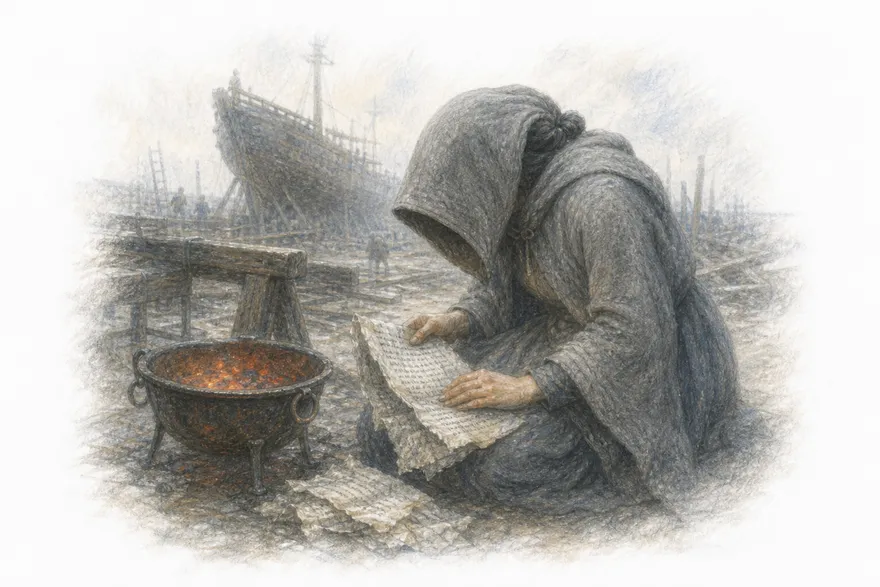
Chapter Six
The Gray Hour
I.
The Cormorant came out of the water like a man getting up from a long illness, slow, and complaining in every joint.
The yard had greased the ways with tallow before dawn, and the oxen leaned into the capstan bars, and the ship that had climbed the last wave of the Dragon’s Breath rose dripping up the timbers an inch at a groan, while the yard master walked beside her hull and listened like a horse-dealer at a cough. His name was Pellow. He was round and aggrieved and very good at his trade, and he had told Rob twice already that he was paid by the tide and not by the bell, and that whatever the priests declared or failed to declare this morning, his slip would be clear by noon if he had to burn what was left in it.
Because that was the morning’s other news, run down the quay at first light by boys who could not keep it behind their teeth: the masters of the great guilds had been bidden to the breakwater before dawn. The Temple read the water today.
Rob had her hold open and emptying before the dew was off the stones. There was little left to shift. The silver had gone to the trades inside a week, the resin and ironwood after it, and what remained was what a long voyage sheds: stove wood, spare cordage, and the factor’s crates, empty now, ten years of another man’s cellar dust still gray in their corners. He worked in his shirt alongside men he was paying by the day, and kept half an eye on the gate, because the priest on the water-stairs had said be found clean, and a man whose name sat in two other men’s books does well to know who comes and goes.
Bram they brought ashore in his nest of oilcloth and tarred wool, the whole bundle at once, two men carrying it like a basket of eggs, and set him down above the tideline with his face to the sea. He woke while Rob was tucking the wool against the wind.
“Gull’s year,” the old man said, to the sky.
“So they tell me.”
“Hungry bird, the gull.” He said it comfortably, a man remarking on weather forty years gone. “Dragons sleep through their own year, often as not. Gulls don’t.” And he went back down into sleep like a man stepping into a boat.
Isobel came through the yard gate while the oxen were being led off, in the grey cloak that made her nobody, hood back, and the sight of her in the wet morning went through Rob the old way, weather he had given up forecasting. She crossed the yard like a woman with one errand left in the world.
“They read the water at midmorning,” she said, with no good-morning in front of it. “My father was bidden to the breakwater before light. I’m telling you what the whole city will know in an hour, while it can still buy you something: you have until the bell.”
“To do what?”
“To finish becoming a man who landed early with nothing on him the law wants. You did half of it when you sold the metal. Do the rest. Be dull for a year, Rob. You’re rich enough now to afford it.”
He grinned at her, salt-cracked, infuriating. “Voss charged me nothing for the same advice,” he said, and watched something go across her face, and called it impatience.
One of Pellow’s men came down the ladder with the last of the cabin gear in a sail-bag, and on top of the bag the ceiling roll, tarred canvas with old knots in it, broken out from behind the lamp where a yard’s hands always look and never ask. “Behind your lamp, captain,” the man said, set it on the trestle by the gangway, and went back up for the rest.
The knot was older than the tar on it. It gave on the trestle, the canvas slumped open, and out of the middle of the factor’s big roll slid a smaller chart, stiff with age, and lay face up between them in the wet light.
It was the home water. The roads, the banks, the harbor’s three mouths, sounded the summer he was nineteen from a leaky skiff of old Pellow’s father’s, with a hand-lead and a conviction that a Vane should hold his own water in his own head and not rent it off the pilots by the trip. The soundings were his, a boy’s figures, cramped and certain, true wherever a skiff had cared to go and blank where it hadn’t. The lettering was the Letterers’ own school hand, ten years old and taking enormous pains, every header ruled twice. He had needed a fair copy, and there was no coin the Master’s small daughter could lawfully take, so she had set her own fee, which was the naming. The rip off the mole-head stood christened Old Boiling. The shoal that walked in every gale was the Liar. And inside the breakwater’s elbow, over honest ankle-water, in letters smaller and more careful than all the rest: Edmund’s Deep, for the brother who all his boyhood would not jump until he had asked what the bottom was. Both brothers had laughed when she unveiled it. The name had held among the three of them ever since, and the chart had ridden in the ceiling of every boat Rob had owned, and he had never told her so, and there it lay.
She picked it up. He watched the reading start, the single pass that went through everything she was ever handed, and watched it stop a third of the way down the sheet. It did not start again. Her thumb found the corner where the paste had let go. She stood in the wet yard holding her own hand at ten years old, and the yard went on greasing and shouting around the two of them, and she said nothing at all.
There was a joke ready. There was always a joke ready. He let it go by.
“It sails where I sail,” he said.
She had drawn breath to answer him when she stopped, mid-word, everything in her gone somewhere over his left shoulder. A yard-boy was crossing behind him with an armful of crumpled paper for the brazier by the saw-pit, where the first armful was already burning.
She went past Rob without a word, took the top sheet off the boy’s load, and smoothed it against her knee. The boy stood very still, as boys do when a strange tall woman in grey turns out to move that fast.
For three breaths she read, in the rising light, a crumpled page that had spent ten years wadded around someone else’s silver.
“Rob,” she said. “Where is the rest of this?”
II.
It was a page of verbs.
Modern Mysoan, the far branch, current and breathing, stamped in metal type, and it was a child’s page: the verb to stand walked through its persons and its seasons in neat ruled rows, with the little tone-marks over the vowels that the chancery hands had dropped two centuries ago. A school book. Somebody on the far shore had printed a grammar, plain as bread, the kind of book a tongue uses to teach itself, and somebody else had torn it up to pack bullion in, and it had crossed the rim of the world as wadding and ridden half a year in a wet hold being nothing.
Eleven years her father’s project had starved. You cannot rebuild a tongue from half of itself; she had said it so often it had stopped being words. The other half was on this paper. The other half was teaching itself, person by person, in her two hands, and the first armful of it was already smoke.
The hold met her like a wall, bilge and salt and ten years of cellar, and she gagged on it, hard, twice, sleeve to her mouth, eyes streaming, furious at her own stomach, and kept her feet and got to work.
They went crate by crate down the dark with one lantern, she and Rob and the quiet sailor with the red thread at his collar, and every crate was lined with it: crushed fistfuls of printed paper, packed tight around where the ingots and the resin jars had sat. Psalm-leaves. Almanac pages, with the far shore’s tide-tables ruled in red. Most of a primer. And the grammar, the grammar, sheet after sheet of it, wherever the packer’s hand had reached that day, ten years ago, in a cellar at the rim of the storm.
“What does it fetch?” Rob asked, handing a crate up into the light.
“To the trades, an hour of kindling.” She did not look up from the sheet she was flattening. “To my father’s house, the other half of a tongue. Price that and I’ll tell you what your ship’s worth in firewood.”
He picked a sheet off the pile and read a line of it aloud, two words in five and those two mangled. She gave the line back to him correctly before she could decide whether to, the vowels long where the tone-marks asked. He repeated it worse, with conviction. She was a full beat late catching that the second mangling was deliberate, and the laugh got out of her before she could catch it, loud in the dark hold, and she heard him bank it for later.
They sacked it like rubbish, because it was rubbish, that was the whole beauty of it; nothing in the world is waved through more gates than other men’s garbage. When the last crate was stripped Rob stood up in the lantern light with his hands black to the wrist and offered her the stove.
“Galley fire’s still in,” he said, and he was not joking now. “Say the word and in ten minutes there’s nothing in this yard but a hauled ship and some silver already sold. Nothing on me. Nothing on you. You walk back up the hill the Master’s daughter, and I’m a dull rich man by supper.” He held her eye. “I’ve been told three times to be clean when that bell rings. This is me telling you once.”
It was a real door, honestly opened, and it was even the wise one. The question of whether she was allowed to refuse it never reached her; questions of permission never did, where a text was concerned, because being able to read a thing had always felt to her like leave to read it.
“No,” she said. Then, because his face was doing its arithmetic: “It can’t come to my house as what it is. It can come as what it looks like. The Letterers buy waste paper by the sack, rag and spoiled sheets, for the pasteboards and the spine-linings. There is a room of it. Nobody has ever once read the waste; I will be sorting these sacks for months and no one will ask me anything except why I’ve taken an interest in rubbish.” She knotted the sack in her hands. “The safest place in this city to hide paper is inside a paper-house.”
Rob looked at her a long moment in the bad light. Then he laughed, one short honest bark, and shouldered the sack, and that was the choice made, both of them inside it together, neither one saying so.
He paid the yard-boy double, for carrying it the wrong way, he said. Pellow watched them sack garbage like plate from his post by the saw-pit and visibly decided, being a man with a slip to clear, that other people’s madness paid the same as sense. At the brazier she made herself walk past without counting. Whatever the fire had taken was verbs now in no language at all, and there was no docket in the world to enter that loss in.
They came up out of the yard gate with a hand-barrow of sacked rubbish, into a city that had stopped pretending to work.
III.
The whole town was tilting toward the water.
Shops stood shuttered with their keepers gone; a man locked his door with flowers already in his cap; the lanes ran one direction, down, everyone walking faster than they meant to, talking louder than they meant to, and the crowd thickened toward the harbor until the barrow had to go single file in the gutter. Nobody looked at them twice. On the biggest morning in eighty years, the one invisible thing in Dorynthos was a man pushing rubbish.
One man looked once. At the mouth of the fish-market lane the crowd split around a stillness in sea-green, a reader with his tablet already out, hem hanging dead in all that hurry, his back to the sea and his face to the people, because the people were his office and the water that morning belonged to greater men. Isobel watched his gaze come down off the faces and touch the barrow and stay, and watched Rob’s face, inside the same half-second, go pleasantly stupid, a man wheeling rubbish on a feast day with nothing in his head at all.
“The yard clears its slip, master?” It was pitched just under the crowd’s noise, so that they had to stop to hear it, and the stopping was the point. The stylus hung over the wax while they stopped.
“Pellow’s,” she said, ahead of whatever Rob had drawn breath to be charming with. “Waste sheets for the binders, rag and spoiled print, bought by the sack. My father’s house sends me to see we’re not sold stones again.” The housekeeping voice, flat as a ruled column. It was the first time the lie crossed her lips, an hour before she would put her name under it, and it came out sounding true, and some cold corner of her made a note of how little that had cost.
The reader considered the sacks for one breath, and her ink-black fingers for a second, longer one. Whatever he meant to ask next, the sea took it from him: out along the breakwater the green line bent all together to the water, grass going over under wind, and the noise of the lanes dropped around them as the city understood that the reading had begun. He wrote one line in the wax, unhurried, a man whose trade had taught him that mornings keep, and went with the turning crowd toward the steps, and did not look back.
Rob had the barrow moving before her breath came back. “Slower,” he said, pleasant, eyes forward. “Hurrying is for the guilty.” She matched him step for step down the gutter, and revised, for the second time that morning, her estimate of what his trade had taught him.
From the fish-market steps you could see the whole of it: the Temple out along the breakwater in the sea-green of the Calm, lead-hemmed, unhurried, a thin bright line between the city and the wide grey water. What they did out there nobody in the crowd could truly see, an old man bending to the sea, they said, reading it like a page. The quiet came up the basin section by section, like the shadow of a cloud crossing, until a hundred thousand people stood in the morning sun making less sound than the gulls.
Then the bell.
The first stroke went through the stones and up through her shoes before it reached her ears, the great bronze bell of the Temple of the Calm telling the city what the water said, and the city came apart. The roar broke front to back, caps and flowers going up, strangers seizing strangers, a woman beside Isobel weeping straight ahead of herself with her market basket still on her arm, and then the harbor answered: ship after ship in the roads ringing back, bell after bell down the long water, until the whole basin rang like a struck shelf of bronze. Eleven lawful months, loosed in one stroke. Two worlds, open for business.
Across the basin, small and yellow and exactly on time, a lamp went up in the stone house on the plague quay, and the Temple’s health-watch hung it and shut their door. No one cheered that. Almost no one saw it.
Rob stood with his face to the breakwater like a man hearing a verdict come in his favor.
“Six days,” he said. “Beat it by six days.”
She thought of her husband at his own supper table, turning his glass: runs from the bell, or reaches back; that’s being argued. She kept it. The day would not have held it anyway, and she was learning what she kept things for.
On the steps below the fish-market an old woman stood out of the cheering like a rock out of a tide. Her thumb was moving on her knuckles, joint to joint around the worn old circle, her lips shaping the beasts, and a granddaughter pulled at her shawl, shouting it’s open, gran, it’s open, and the old woman said, “I hear it.” Her thumb stopped. Isobel, who had grown up counting the same circle on her own two hands, knew to the knuckle where: two joints short of the dragon. The old woman looked up then, and found Isobel looking back, the only two still faces on the steps, and something passed between them with no words in it at all, the kinship of people who can count.
The Letterers’ lane was empty, the whole house at the water. At the buying-door she signed the sacks in herself, in the day-book’s fair ruled column: waste sheets, divers, bought of the yard at Pellow’s slip, for the binders’ use. Her own hand, her own name, the second false entry of her life, and this one with her fingers still black from the making of it. Rob set the last sack inside the door himself, and for a moment they stood in the cool dark of the waste-room with the bells coming through the walls, and neither of them was foolish enough to say anything to the other that the morning could not afford.
“Go and be seen cheering,” she said. “It’s the best alibi this year will ever sell you.”
He went. She stood among the sacks and listened to him go, and then there was only the city, roaring its luck, and the bells.
They rang on, brazen and certain, telling two worlds the old words still held. It was the gull’s year. The bells were a year and more early, and the city knew how to count, and the city cheered anyway.
She bolted the waste-room door behind her and went up to the cold table to begin.
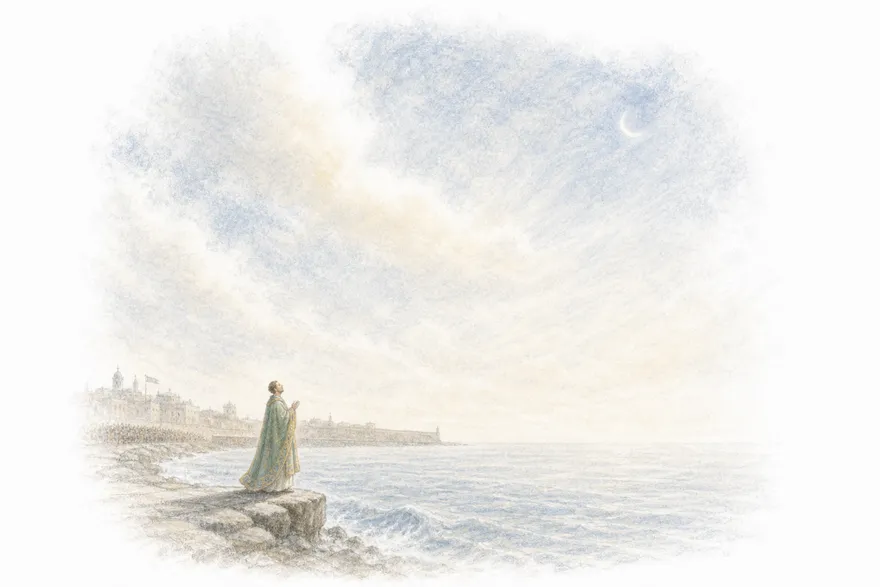
Interlude
The Reading of the Water
No man alive had ever sung the year open.
The versicle of the Opening is sung once in eighty years, by one voice, from the last stone of the breakwater, and the men who hold the office learn it from a book, because there is no other way left to learn it. Brother Solen had been precentor of the Temple choir for nineteen years and a chorister for fifty-one, since the morning his father sold his voice up the hill against a baker’s debt, and in all those years the Office of the Opening had lain in its cedar box in the song-loft, wrapped in waxed linen against the salt air, taken out four times a year to be aired and sung from in a whisper. Six men had sung it aloud since the book was bound. Their entries stood in the colophon column at the back, one line to a man, the same line every time, the ink browner the higher up the page you read: Sung at the Opening, in the year of the golden dragon, as appointed. Between any two of those lines lay four or five precentors who had rehearsed all their lives and gone into the ground with the box shut. The book was a record of singers the way a sea-wall is a record of storms: mostly it remembered the waiting.
He knew its margins better than his prayers. Do not hurry the versicle, in a hand three entries dead. The wind off the water takes the third note; give it more than you think it owes you. And over the second word, set there by a hand earlier than any of the signatures, a small arc, a singer’s mark: held. He had obeyed these men in the loft ten thousand times, quietly, for nobody. His own master, Cale, who had the better voice and said so without vanity, had drilled him across thirty years and died in the spring, in the gull’s year, with the box shut. By the appointed count Cale had been owed two more years of waiting and would likely have missed the morning anyway, and there had been a thin comfort in that arithmetic once. The sea had since taken the comfort back. The sea had come early, and turned a certain miss into a near one, and Solen had found that a season is a crueler margin than a beast. The count had cheated Solen too, of a smaller thing. The rubric set aside the year before an Opening for the open rehearsal, the versicle at full voice in the shut loft, a twelvemonth of growing the body into the sound, and by the count that year had not yet come. He had sung the office all his life and never once aloud.
The summons came before the dawn bell, six days after the ironwood keel stood into the harbor. The readers had walked out each morning of those six days and come back without declaring, and everyone in the city knew why, and nobody in the Temple said it: the answer was already riding at one of the moorings, black, salt-burned, plainly arrived, while the plague-lamp stayed dark and the rumor ran the lanes like water finding a drain. On the seventh morning they took the precentor with them.
They dressed him in the song-loft by lamplight, because no man alive knew the order of it and the sacristan worked from his own book, propped open on the chest, reading the rubric half to Solen and half to himself. The Opening cope came up out of cedar shavings where it had lain since before either of their grandfathers: sea-green silk gone grey along the folds, lead beads sewn into the hem so it would hang still in a sea wind, cut two hundred years past for a bigger man, so that the sacristan pinned it at the shoulders as you would pin a boy’s first cassock. It smelled of cedar and myrrh and, under those, faintly of the sea, which no one had ever explained. The sacristan’s hands shook worse than Solen’s did. He had waited a lifetime too. His share of the morning was the pins.
The order of the procession was the order of the Temple turned over. Every other day of the year the precentor walked where singers walk, behind the readers, behind the provosts with their chains of office, a craftsman among governors. The rubric for the Opening set it the other way around: readers first, then the provosts, then the choir, and last of all, behind everyone, the one man with the morning’s work still in front of him, because on this one road the last place is the highest. Men who had outranked Solen his whole life arranged themselves ahead of him like outriders. The first provost, going to his place, stopped and bowed. Solen had served under four first provosts, and not one of them had ever learned his name past Brother, and this one bowed to him, and Solen understood that the bow belonged to the office and not to him, and found it heavy anyway.
Two paces behind his left shoulder walked Brother Annet, the under-precentor, nineteen years his junior, who had learned the versicle whole, as the rubric required, against the chance that the precentor’s voice cracked on the morning. In nineteen years the two of them had never once spoken of that clause. Solen could feel the man’s eyes between his shoulder blades the whole length of the breakwater, and did not blame him.
They went out along the stones in the grey before sunrise, lead-hemmed silk hanging still as standing water, and the quay crowds thickened with every stone. On a mooring bollard a knot of children chanted the beast-count at the priests as they passed, crab and gull and hare and hound, sixteen beasts to bring it round, meaning nothing by it but the holiday. Solen’s thumb found his knuckles inside his sleeve without being asked, and stopped where it stopped now, two joints from the dragon, and he laid the hand flat against his thigh and walked.
At the last stone the choir formed and the readers went down the green stair to the water, and the whole line of them bent to it together at the first reader’s sign. Behind him, section by section, the city went quiet. He had never stood under a quiet like it; it came up the basin from the fish-market like a weather, a hundred thousand people deciding one after another to hold their breath, until there was only the wash on the stones and the gulls, who kept no holy days.
The first reader read the sea the slow way, wet to the knees on the bottom step, counting the long sets against his beads, looking at the weed, the birds, the light in the water, the things the rubric named and the things it only trusted him to know. It took the better part of an hour. When he came up the stair his face had the no-expression that Solen had sung under for fifty years, and one of the other readers stepped to him and said something low, of which the wind brought Solen three words. The rolls. The gull. The count.
The first reader did not lower his voice, which Solen understood, much later, to have been the whole of the answer. “She has been open six days,” he said. “Every soul on that quay can read her. What is left to decide is whether the Temple can.” He looked at the harbor while he said it, at one mooring in particular, and then he turned to the precentor and gave the only order that morning had ever been going to give.
“Sing it, then.”
Solen had rehearsed dying better than he had rehearsed this. He set his feet on the last stone of the breakwater with two worlds of water in front of him and a silent city at his back, and sang the versicle whole, in the old tongue, the grandmother of the blessing the priests sang over keels, words he could sing perfectly and could not have told you the meaning of, and neither could the man who taught him, nor the man who had taught Cale; they knew how it went, and that was the office, and it was enough. He did not hurry it. He gave the third note more than he thought it owed him and the wind took its share and left the line standing. At the second word he held the arc as a hand five centuries still had marked for him to hold it, longer than his lungs liked, and in the holding he heard his own voice go out over the water and come back from nowhere. In fifty-one years of singing he had never made a lonelier sound: one voice against the width of the world’s whole roof.
The sea did as it pleased, which that morning was to lie quiet. The first reader’s banner went down off the head-stone, and away across the basin the great bronze bell took it up, and the first stroke came back to them along the breakwater through the stones underfoot, and behind it the city came apart. The roar crossed the water a breath behind the sight of it, caps and gulls going up together, and ship after ship in the roads began to ring, and Brother Solen stood with the book closed in his two hands and found his face wet, and let it be wet, because a man may weep at his own wedding. Beside him Annet had gone down on his knees on the stone, which was nowhere in the rubric. When he rose his face was wet too, relief and grief together, because the versicle was sung now for the rest of both their lives, and a man can grieve to be let off the one great thing he was kept for. Solen had worn that face himself for thirty years under Cale. He looked away from it, out of courtesy. He did not look at the mooring the first reader had looked at either. He had a lifetime’s practice at not hearing the lane noise under a psalm, and he spent all of it, and sang the responses home.
Coming back along the stones, Annet told him, shy of it, that through the whole of the held word he had not seen him breathe, nor blink, and by the Temple stair the choir behind them had settled on the word they would keep for the morning, which was grace. Solen let them have it. He was tired in a still way he had no word for, and sleep, he would find, was not going to lift it for some nights to come.
That evening, in the loft, with the city still roaring below and the candle steady in its tin, he opened the book to the colophon column and dipped his pen and wrote the seventh line in his fair round office hand: Sung at the Opening, in the year of the gull. The formula had four more words. He sat with them while the candle burned down a knuckle’s worth, six dead men’s lines above his own, every one appointed, and then he cleaned the pen and shut the book on the blank, where whoever sang it next would find it, eighty years on, and understand that the man before him had seen, and sung anyway, and written down only what was true.
It was as much heresy as he had voice for.